How to evaluate an AI transcription tool: a complete guide for general and advanced users
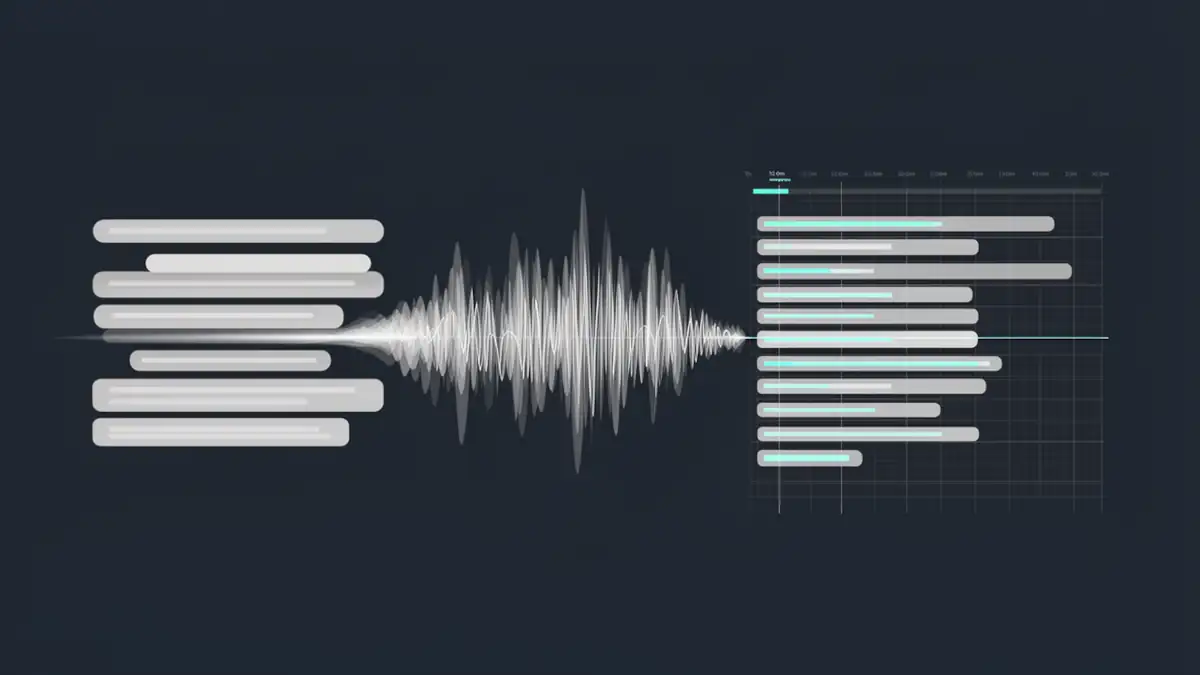
Artificial Intelligence transcription tools have become widely accessible. From professional meetings and YouTube videos to podcasts and online courses, a multitude of solutions can now transform an audio file into text in minutes.
However, one question remains: how do you know if a transcription tool is actually good? The answer is more complex than it seems, because it depends entirely on what you expect from the text. A tool can be excellent for generating readable subtitles, yet fail significantly when the text serves as a source for analysis, citation, or automated processing.
This guide proposes a progressive methodology to evaluate AI transcription tools, first from a general user perspective (meetings, subtitles), and then from a technical and methodological standpoint for advanced users and engineers.
Why the notion of “accuracy” is misleading
Most comparisons focus on accuracy or global quality. While these terms are reassuring, they are rarely well-defined. A transcription tool can be pleasant to read, fast, and fluid, all while subtly altering the speaker’s original intent. Conversely, a raw, less elegant transcription might be far more faithful to what was actually said.
Before comparing tools, it is crucial to understand that there are several levels of quality, each serving different purposes. For a deeper look into the limits of accuracy metrics, see our article Why raw accuracy is a trap in speech-to-text evaluation.
Step 1: define your actual use case
The most common mistake is comparing tools without identifying the final objective.
Case 1: general use cases
You fall into this category if you want to:
- transcribe a meeting for records,
- generate subtitles for a YouTube video,
- turn a podcast into readable text,
- save time on note-taking.
In these situations, the critical criteria are usually speed, ease of correction, readability, cost, and subtitle timing. Absolute word-for-word fidelity is not critical.
Case 2: editorial and analytical use cases
You enter a different category if the transcription is used to:
- precisely quote a speaker,
- write an article or research paper,
- analyze a discourse,
- feed a search engine or a RAG (Retrieval-Augmented Generation) system,
- reliably archive content.
Here, the transcription becomes a textual source. Errors are no longer trivial: an insertion, a reformulation, or an omission can change the entire meaning of a statement. This is where “comfortable” tools reach their limits. For a concrete case study comparing Whisper large-v3 and YouTube subtitles in an editorial context, see our Technical Evaluation of Whisper large-v3 vs YouTube Subtitles.
Step 2: what to test for simple usage
For general usage, there is no need for complex metrics. Focus on these practical questions:
- Is the text understandable without effort?
- Can I quickly correct errors?
- Are the subtitles well-synchronized with the video?
- Does the tool correctly recognize sentence breaks?
- Is the cost acceptable for my volume?
In this context, integrated solutions like automatic subtitles on video platforms are often more than enough. These systems are optimized for accessibility and real-time reading, sometimes tolerating paraphrasing to maintain a readable flow. This is a design choice, not a flaw.
Step 3: when transcription becomes an asset
The shift occurs when you start copying and pasting phrases from the transcription, analyzing arguments, or automating data processing from the text. At this stage, an approximate transcription can weaken an argument, introduce bias, or create false quotes. The question is no longer “is it readable?”, but “is it faithful?”.
To understand how to choose the right configuration of a Whisper model for these needs in 2026, you can read our guide Choosing your Whisper model in 2026: performance, precision, and hardware.
Step 4: understanding metrics (without falling into traps)
Word Error Rate (WER) in a nutshell
The Word Error Rate (WER) is the most common metric for evaluating speech recognition systems. It measures:
- Substitutions (one word replaced by another),
- Insertions (an added word),
- Deletions (a missing word),relative to a reference transcript. While it is a useful indicator, it remains incomplete.
Why a single score is misleading
Two transcriptions can show the exact same WER while being radically different in quality. An error on a minor article (“a” vs “the”) counts the same as an error that inverts the meaning of a sentence. Furthermore, a global average can hide local zones of complete failure. A good global score does not guarantee a good transcription where it truly matters. For more on this methodological bias, refer to Why raw accuracy is a trap in speech-to-text evaluation.
Step 5: a robust methodology for advanced users
This section is for those who need to evaluate a transcription tool beyond mere intuition.
Choosing a representative corpus
Avoid marketing demos. Use real-world audio with a clearly defined use case, sufficient duration, and documented conditions (language, speaker variety, audio quality). Without this, any conclusion is fragile.
Proper audio-to-text alignment
Comparing two transcriptions without verifying their temporal alignment is a classic mistake. A shift of just a few seconds is enough to skew any segment-based analysis. Any serious evaluation must begin with clean time-stamping and alignment.
Analyzing over time, not just averages
Breaking the transcription into time windows (e.g., 10-second segments) allows you to:
- detect problematic passages,
- identify exactly where the tool fails,
- understand when and why errors occur.Differences often only become visible during complex, conceptually dense segments.
Step 5b: The challenge of speaker diarization
For advanced users, especially in professional meetings or multi-guest podcasts, transcription is only half the battle. Speaker Diarization, the process of partitioning an audio stream into homogeneous segments according to the speaker’s identity, is a distinct technical challenge.
- Accuracy vs. Overlap: Most ASR models, including standard Whisper, struggle with overlapping speech. Evaluating a tool must include its ability to handle “cross-talk” without attributing one speaker’s words to another.
- Consistency: A robust tool should not only detect a change in speakers but also maintain the same identity (e.g., “Speaker 1”) throughout the entire recording.
- Integration: Advanced pipelines often combine Whisper for the text and models like Pyannote for the diarization. If your use case involves complex debates or interviews, testing the “Diarization Error Rate” (DER) is as essential as monitoring the WER.
Step 6: interpreting results correctly
The hardest part is interpreting results without drawing false generalizations.
Why two honest studies can reach different conclusions
It is common for two benchmarks to conclude differently about the same tool. This does not mean one is wrong, but rather that they may have used different corpora, had distinct objectives (accessibility vs. fidelity), or used poorly defined metrics. The key question is not “who is right?”, but “what specific question is each study answering?”.
Step 7: choosing the right tool for the right job
Summary for general use
For everyday tasks, prioritize integrated platform tools or fast solutions with a good correction interface. Minor errors are acceptable as long as the text is understandable and manual correction is swift. Readability outweighs absolute fidelity.
Decision matrix: which transcription tool for which use?
| Primary Use | Fidelity Requirement | Key Priority | Recommended Tool Type | Human Review |
| YouTube Subtitles | Low to Medium | Readability, timing | Platform auto-captions | Optional |
| Meetings / Personal Notes | Medium | Speed, convenience | General AI STT tools | Occasional |
| Editorial Podcasts / Videos | Medium to High | Clarity of intent | Optimized Whisper model | Recommended |
| Articles, Quotes, Analysis | High | Lexical fidelity | Whisper large-v3 or equivalent | Essential |
| Research, RAG, NLP | Very High | Reproducibility | Full methodological pipeline | Structured & Targeted |
| Interviews / Multi-guest | High | Speaker ID & Fidelity | Whisper + Diarization (Pyannote) | Essential |
Key takeaways
Before selecting or evaluating an AI transcription tool, systematically ask:
- What is the purpose? Reading, subtitling, analysis, or automation?
- Which errors are acceptable? Minor typos or structural changes?
- Is human review feasible? And on which specific parts?
- Is reproducibility required? Should the same audio always yield the same text?
Conclusion
AI transcription tools have reached a maturity level that covers most daily needs. However, their evaluation is too often limited to subjective impressions or misinterpreted scores.
For the general public, readability and speed are usually sufficient. For editorial, analytical, or automated workflows, a more rigorous approach is indispensable. The real question is not “Which is the best AI transcription tool?”, but rather “Which tool is reliable for my specific use case, what are its limits, and how can I verify them?” Only then does AI transcription become a trusted asset rather than a silent source of error.
Your comments enrich our articles, so don’t hesitate to share your thoughts! Sharing on social media helps us a lot. Thank you for your support!