
Highlights


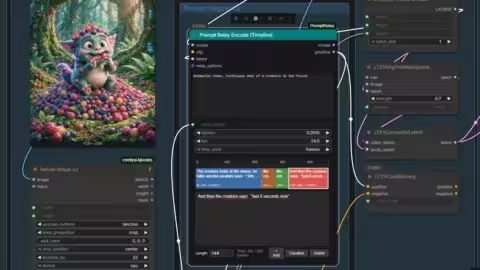

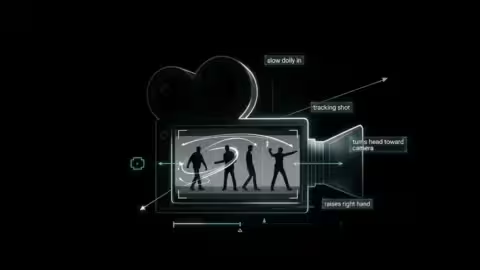
Prompting LTX 2.3: The Techniques That Actually Work
LTX 2.3 is capable of producing impressive videos locally, but it is also far more demanding than most image generation models. Many users quickly discover that prompts that work perfectly…
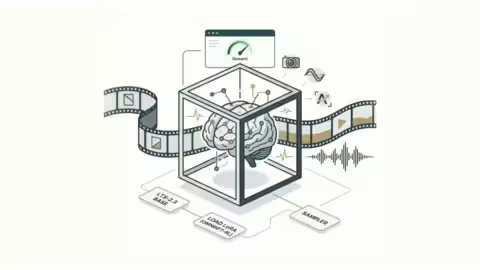
OmniNFT for LTX-2.3: Alignment via reinforcement learning
The LTX-2.3-OmniNFT-RL-Lora_bf16.safetensors file, hosted on Kijai’s ComfyUI repository, is drawing significant curiosity from the open-source AI video community. Far from being a standard artistic style filter, this adapter introduces an advanced optimization framework…
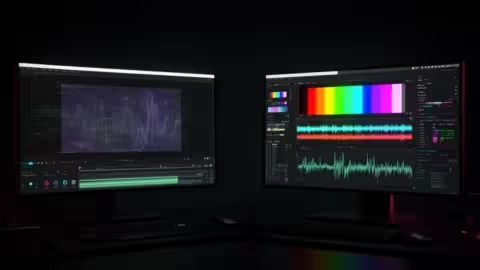
Why Your Video Player is Sabotaging Your Production (And What to Choose in 2026)
I. The Video Playback Paradox: Fidelity vs. Complacency In the world of broadcasting, a good player is one that manages to play a corrupted or poorly encoded file without stopping….

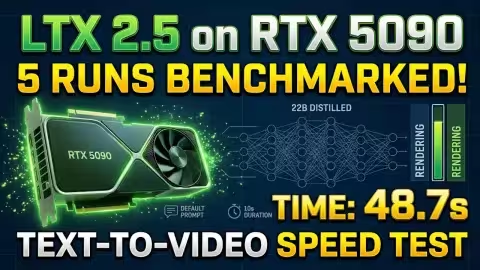
RTX 5090 Benchmark: Flux.2 Dev Performance in FP8 and GGUF
Local AI inference performance is traditionally evaluated through a binary metric: whether a model fits entirely within physical VRAM. In the contemporary local AI ecosystem, this paradigm is shifting. Factors…

LTX-2.3 vs Wan-2.2: Which Open-Source AI Video Model Should You Run Locally in 2026?
The 2026 Sora shutdown was a wake-up call: depending on a single giant for video creation is a strategic risk. As proprietary alternatives become overpriced, savvy creators are pivoting to Local-First. Meanwhile,…

Reliability and Contextual Drift: Why LLMs Lose Track in Long Contexts
The evolution of Large Language Models (LLMs) in 2026 is defined by an aggressive race toward ever-larger context windows. With models now capable of processing hundreds of thousands—even millions—of tokens,…

RAMmageddon 2026: Why Soaring Memory Prices Are Redefining PC Hardware
As of April 2026, building a PC has become a high-stakes financial balancing act. What analysts now call RAMmageddon, or “RAMpocalypse” for the more fatalistic, signals a turning point for…

Mastering Awesome GitHub: The Engineering Guide to Human-Curated Open Source
In the vast entropy of GitHub’s 400+ million repositories, discovery is the ultimate bottleneck for engineering velocity. While search algorithms and AI assistants offer quantity, the “Awesome” prefix has established…

The steep bill of AI agents: the illusion of low-cost autonomy
The promise of a “digital employee” available 24/7, capable of managing emails, coordinating projects, or monitoring customer service without fatigue, is the great hallmark of 2026. For freelancers, SMEs, or…

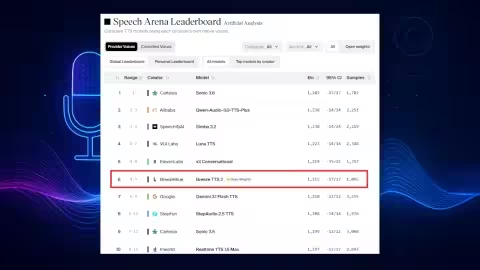
Fish Audio S2 Pro: How to Use a Voice Reference for High-Fidelity Voice Cloning
Fish Audio S2 Pro represents the state-of-the-art in multilingual text-to-speech, leveraging an asymmetric Dual-Autoregressive (Dual-AR) architecture—combining a 4B parameter Slow AR model with a 400M parameter Fast AR model—to deliver industry-leading voice…

The Sora Sunset: Decoding OpenAI’s Strategic Retreat from Generative Video
The sudden discontinuation of Sora in early 2026 marks a watershed moment for the generative AI industry. Once hailed as the “Hollywood-killer” during its viral unveiling, the model has been…
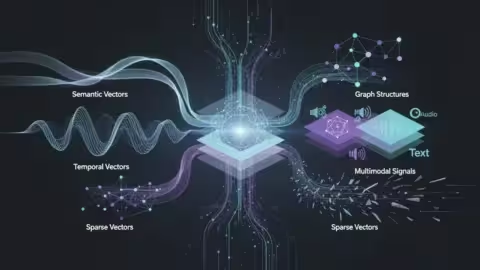
Beyond semantic search: Architecting the multi-vector RAG stack in 2026
In the early days of the generative AI boom, semantic search was hailed as the definitive solution for knowledge retrieval. By 2026, however, the industry has reached a “vector plateau”….

Local AI Video on RTX: Mastering the NVIDIA 3D-to-Diffusion Workflow
Local AI video generation in 2026 is undergoing a radical structural shift. For too long, creators have been held hostage by the “slot machine” nature of Text-to-Video (T2V) and Image-to-Video…

RTX Video Super Resolution in ComfyUI: Neural Upscaling at the Service of Creative Workflow
The challenge of scaling in artificial intelligence workflows has long relied on a frustrating compromise between execution speed and visual fidelity. Traditionally, ComfyUI users had to choose between resource-hungry diffusion…

The LLM-Ready Web: A Battle of Semantic Extraction (Firecrawl vs. Crawl4AI)
In the race to build production-grade RAG systems, architects often overlook the most critical failure point: the data ingestion layer. While LLMs are scaling in reasoning capabilities, they are still…

The AI-First Organization: From Hierarchical Control to Agent-Driven Symbiosis
The year 2026 marks a definitive inflection point in corporate evolution. We are witnessing the transition from “AI-augmented” legacy firms to the AI-first organization. This shift is not merely a digital…
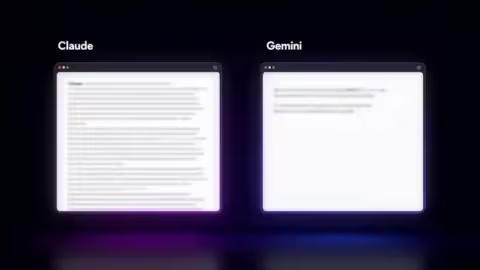
The Architectural Ceiling: Why Gemini 3.1 Pro and Claude 4.6 Opus Diverge on Output Length
In 2026’s high-stakes Large Language Model landscape, a structural divergence has become a primary friction point for power users: the “Output Length Gap.” While Google’s Gemini 3.1 Pro (released Feb 19, 2026)…
Best GPU for Local AI in 2026: Deep Dive on VRAM, Energy, and Real Benchmarks
Running large language models on your own hardware has reached a critical inflection point in 2025-2026. This isn’t just a question of technical curiosity or cloud cost-cutting—it’s become a compliance,…

The Millisecond War: Decoding LLM Inference Performance in 2026
In the 2026 AI ecosystem, raw model intelligence is no longer the sole metric of success; generation speed, measured in tokens per second (token/s), has become the ultimate competitive frontier….

The illusion of the trust layer: securing LLM prompts through interception
The rapid integration of Large Language Models (LLMs) into the corporate workflow has birthed a significant security paradox: how can an organization leverage generative intelligence without its industrial secrets, proprietary…