Securing agentic AI: the MCP ecosystem and smolagents against terminal chaos (2026)
The recent audit of Claude Code and GPT-5.3 Codex failures has highlighted a structural limitation: granting direct shell access to a probabilistic model mechanically increases exposure to execution errors. It is no longer just a matter of optimization, but of managing operational risk.
In 2026, the industry is not retreating from performance, especially regarding long contexts and multi-step consistency, but it now recognizes that raw power is insufficient. To move beyond experimental “terminal-first” approaches, two architectural pillars are emerging: the Model Context Protocol (MCP) and the smolagents framework. Together, they structure an AI that is better governed, more isolated, and compatible with real-world DevOps requirements.
If you want to understand how these limitations fit into a broader transformation of software development, our pillar page AI Coding Agents: The Reality Beyond Benchmarks provides a structured and fact-based overview.
1. The Model Context Protocol (MCP): establishing diplomatic language
Conceived by Anthropic, the Model Context Protocol (MCP) acts as a universal and secure translator between artificial intelligence and your data. Rather than letting an agent explore your system blindly, MCP imposes a strict conversational framework.
1.1 From improvisation to dynamic discovery
Until recently, traditional function calling forced developers to define each tool manually within the prompt—a static and fragile method. With MCP, we are moving toward dynamic tool discovery during execution.
The agent no longer possesses “administrator” rights by default. It queries the MCP server to determine what it is authorized to do at any given moment. This approach transforms the AI from a potential intruder into a collaborator whose scope of action has been carefully limited.
1.2 The triumph of least privilege
In this new ecosystem, an MCP server can be configured to expose only documentation-reading or database-querying capabilities. Direct access to the host system is strictly prohibited.
Every interaction becomes typed, declared, and, most importantly, auditable. This decoupling does more than just reduce the attack surface; it creates logical isolation. If a tool encounters an error, the crash remains confined to its specific function, preventing the corruption of the entire agent or the ongoing project. We are no longer discussing a monolithic block, but rather a segmented and pluggable architecture.
2. smolagents: the art of high-security execution
While MCP defines the perimeter of accessible tools for an agent, the smolagents framework from Hugging Face structures how it executes its actions. Its philosophy represents an evolution: instead of producing only text or JSON describing an action, agents generate and execute code (primarily Python in current implementations) within a controlled environment.
2.1 The CodeAgent: scripted intelligence
The CodeAgent paradigm shifts the classic approach. Instead of allowing the AI to improvise often-fragile shell commands, smolagents prioritizes the generation of explicit scripts.
This method allows for more granular data manipulation; the agent can write a targeted script to read or modify a specific portion of a file, rather than rewriting its content in bulk. Combined with an isolated environment (Docker, E2B, etc.), this approach significantly reduces the risk of destructive errors. This helps avoid hazardous shell commands, such as the CAT pattern observed with Codex.
2.2 Sandboxing: building a golden cage
The security of smolagents is based on a precautionary principle. To prevent any Remote Code Execution (RCE), the framework deploys several shields:
- Import restrictions: The agent can only use a whitelist of authorized modules.
- Isolated environments: Code never runs directly on your machine. The official documentation recommends using Docker containers or solutions like E2B to ensure total containment.
This isolation transforms the terminal—once a danger zone—into a secure laboratory where every command is a test with no consequence for the host.
3. Convergence: toward a trust-based architecture
In practice, MCP and smolagents are not rivals, but rather two sides of the same coin. One secures access to resources, while the other secures the execution of actions.
3.1 Hybrid orchestration in production
In 2026, the most robust architectures rely on a specific triptych:
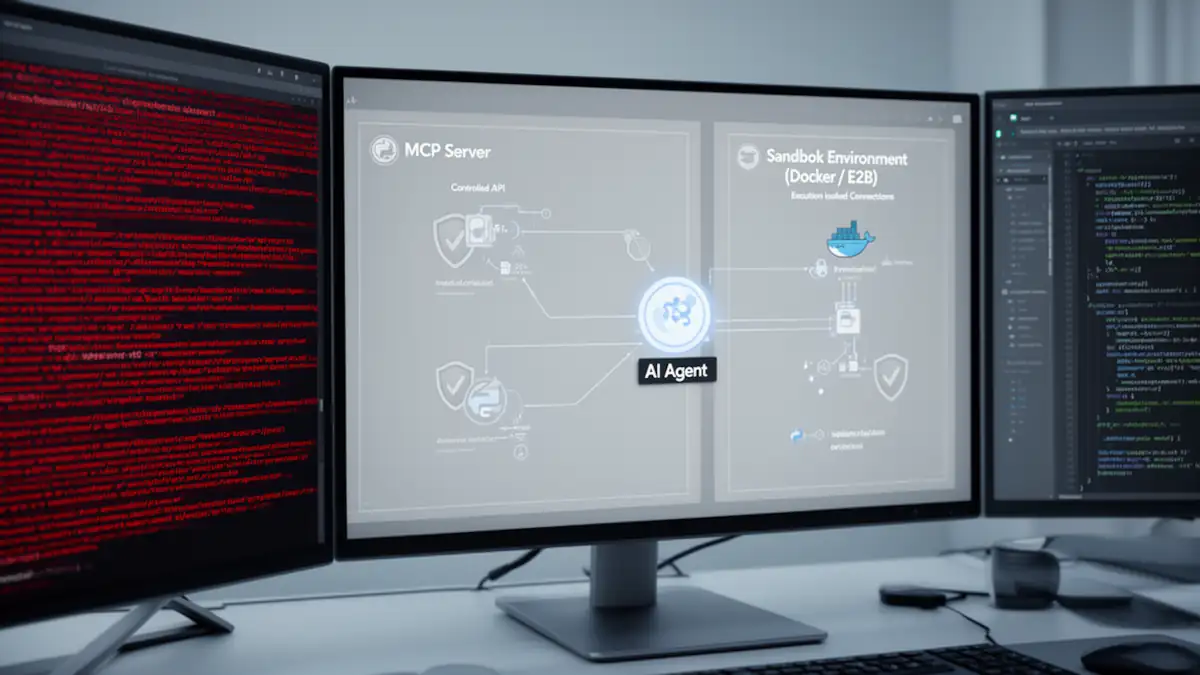
- Governance (MCP): The agent queries a Model Context Protocol server to retrieve data schemas or access third-party APIs without ever obtaining raw secret keys.
- Isolation (smolagents): Retrieved data is processed by a CodeAgent that generates a script (primarily Python), executed in an E2B or Docker sandbox.
- Supervision (HITL): The framework imposes a systematic pause before any destructive action, allowing a human to validate the agent’s plan.
This structure addresses the “Ghost Execution” issue observed during Codex desynchronization incidents. The AI can no longer act in the shadows of the terminal; every intent is traced and every execution is confined.
3.2 The new role of the developer: from author to auditor
The massive adoption of these protocols is radically transforming daily workflows. As highlighted by the SemiAnalysis analysis of the Claude Code inflection point, we are moving from an era where developers write code to an era where they orchestrate intelligence flows.
The developer is becoming a guarantor of security policy. Their expertise is no longer measured by typing speed, but by their ability to configure granular MCP servers and audit agent execution logs. This is a major technological transition: AI is becoming a new orchestration layer above traditional application code.
Toward a “zero trust” AI era
The era of an open shell without safeguards has reached its technical and security limits. Current developments prove that reliability has become a more valuable metric than the mere raw performance of models.
MCP brings diplomacy and governance, while smolagents brings containment and isolation. Together, they shift the debate: the challenge is no longer just whether AI can code, but defining the secure framework in which we allow it to act.
In our next deep dive, we will move from theory to practice with a survival guide for AI-augmented engineers: how to orchestrate these components to maintain total control over production without sacrificing delivery speed.
Your comments enrich our articles, so don’t hesitate to share your thoughts! Sharing on social media helps us a lot. Thank you for your support!