Choosing your Whisper model in 2026: performance, precision, and hardware
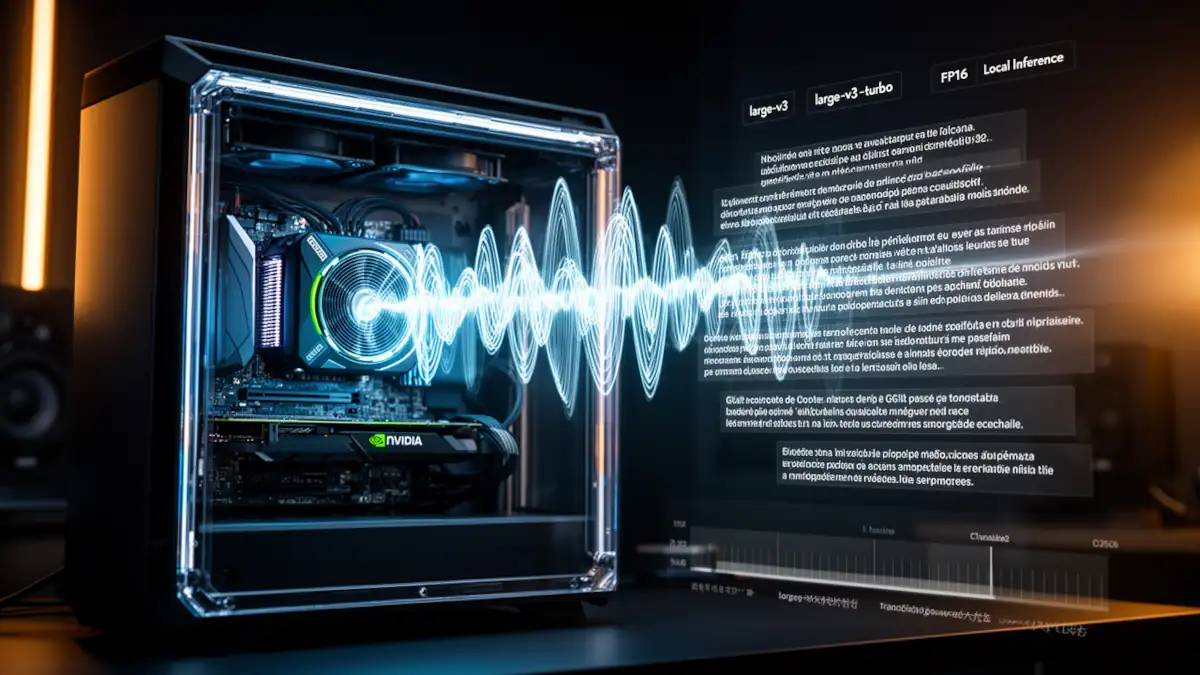
The Automatic Speech Recognition (ASR) ecosystem has reached a major milestone this year. While cloud-based solutions long held the advantage, the power of local GPUs, such as the RTX 5090 or 5080, now allows for the execution of state-of-the-art models with formidable efficiency. Although these observations apply to more accessible hardware at a different scale, selecting the right model is no longer just about size, but about software optimization.
This article guides your selection based on precision requirements, hardware constraints, and specific workflow needs, particularly for multilingual and high-stakes content.
The Whisper model hierarchy in 2026
While new competitors like NVIDIA’s Canary or IBM Granite Speech show impressive results in English, Whisper large-v3 remains the gold standard for multilingual tasks, especially for complex languages like French.
Whisper large-v3: the benchmark for fidelity
The Whisper large-v3 model remains the primary choice for those who prioritize editorial precision above all else. Its performance varies by source: approximately 7–8% WER on clean datasets like LibriSpeech, and between 10% and 13% on real-world, noisy multilingual content such as podcasts or YouTube videos. It excels at capturing linguistic nuances where lighter models often fail.
Whisper large-v3-turbo: optimized decoding
Contrary to common misconceptions, the large-v3-turbo model is not a compressed version, it retains the same ~1.55B parameter count as large-v3. The optimization lies in accelerated decoding and behavioral distillation. It is an alternative that prioritizes speed, offering precision close to large-v2 but with significantly higher responsiveness, making it ideal for massive volume processing.
Hardware optimization and inference backends
Owning a high-end GPU like the RTX 5090 with 32GB of VRAM is a strategic advantage, as the choice of software implementation radically defines the memory footprint and processing speed.
The whisper-ctranslate2 advantage
For local execution, using whisper-ctranslate2 is highly recommended. This backend, powered by CTranslate2, enables massive speed gains while optimizing resource consumption. For a large-v3 model in fp16, expect about 8–12GB of VRAM usage with the standard PyTorch implementation, compared to only 3–5GB via CTranslate2.
Leveraging the power of the RTX 5090
With 32GB of VRAM, memory constraints virtually disappear. This allows for the use of FP32 for absolute fidelity or the parallelization of multiple instances through tools like insanely-fast-whisper. For content creation and subtitling workflows, this power reserve ensures total fluidity even during simultaneous recording and processing.
Performance and use case comparison
| Model | Precision (Real-world WER) | VRAM (CT2 fp16) | Recommended Use |
| large-v3 | ~10–13% | ~4.5 GB | Editorial, Analytics, RAG |
| large-v3-turbo | ~13–15% | ~4.5 GB | Fast subtitling, Real-time |
| medium | ~18% | ~2.5 GB | Quick sorting, Basic indexing |
Selection criteria for your project
When to prioritize maximum precision?
If your transcription serves as the foundation for semantic analysis or a Retrieval-Augmented Generation (RAG) pipeline, the large-v3 model is indispensable. As highlighted in our analysis of the limits of raw accuracy, reducing structural errors is far more important than pure speed.
When to opt for speed?
For mass subtitling or keyword searching, the large-v3-turbo model is a viable option. On an RTX 5090, using the command whisper-ctranslate2 --model large-v3-turbo --compute_type float16 achieves record processing times without sacrificing overall readability.
Moving toward optimized local integration
Choosing the right Whisper model in 2026 depends on balancing the complexity of your source with your available computing power. For an expert user, the combination of large-v3 and the CTranslate2 backend currently offers the best compromise between speed and semantic fidelity.
The evolution of competing models, while promising, has yet to dethrone Whisper’s universality for intensive local processing.
Your comments enrich our articles, so don’t hesitate to share your thoughts! Sharing on social media helps us a lot. Thank you for your support!