Agentic engineering guide: orchestrating agents and mastering the “Vibe Coder” shift
The evolution toward AI-assisted development in 2026 marks the end of the “pure executor” coder, giving rise to the agentic engineer. In this new ecosystem, we must distinguish “Vibe Coding”—often associated with improvised, intuitive practice—from agentic engineering, which embodies the developer who orchestrates agents with rigorous methodology. While Vibe Coding has captured the collective imagination as a creative entry point, it now faces the demanding reality of professional production. For the expert, the challenge is to transform that “vibe”, the fluid dialogue with the machine, into a robust system that guarantees the longevity of enterprise architectures.
Here are the keys to orchestrating your agents with engineering rigor while leveraging the agility of agentic architectures.
1. Entity creation: from solo agents to specialized profiles
Before orchestrating a system, you must define your work units. In 2026, we no longer simply “prompt” an AI; we configure agent profiles (or “Skills”) with strictly delimited roles and permissions.
Declarative profiling and context isolation
In modern tools like Claude Code, creating an agent involves a configuration that defines specific components:
| Component | Strategic Role | Technical Impact |
|---|---|---|
| Dedicated Profile | Specialization (Reviewer, Tester, Coder) | Reduces cognitive bias in the model |
| Context Isolation | History containment | Prevents global reasoning pollution |
| Tool Permissions | Capability control (Read, Write, Execute) | Applies the principle of least privilege |
| Control Hooks | System call interception | Enables a real-time audit trail |
This approach limits fan-out (the ability of an agent to spawn uncontrolled sub-tasks), ensuring the architecture remains predictable and auditable.
2. Agentic engineering: designing the PEV system
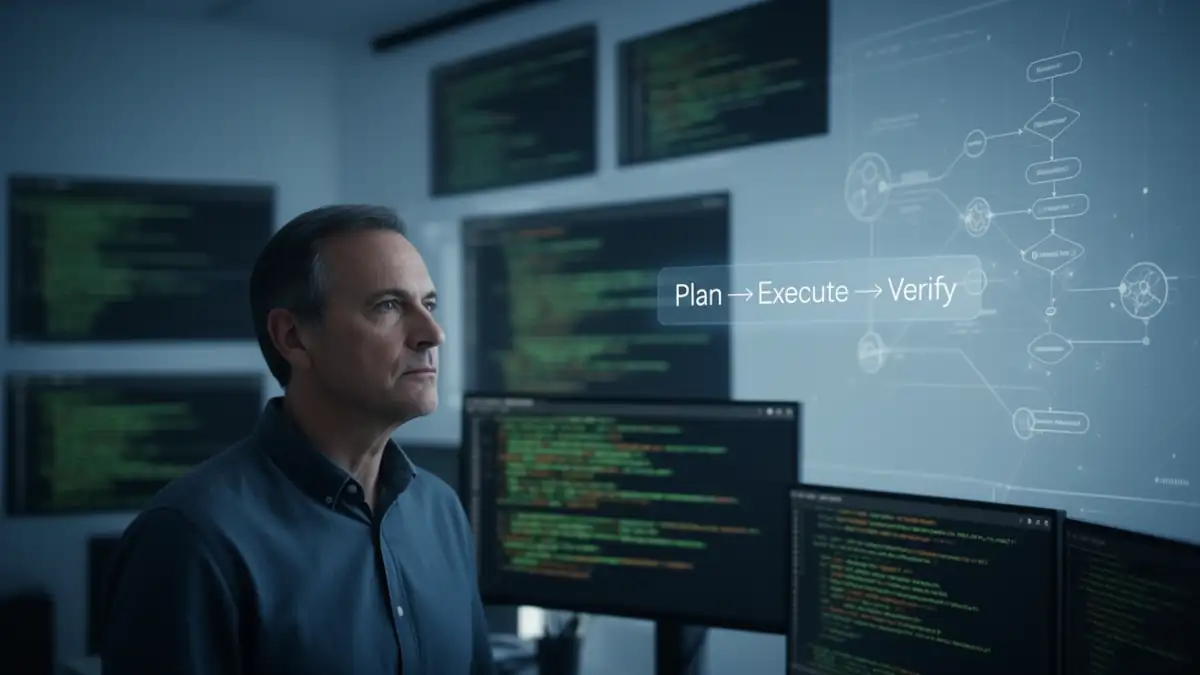
Agentic engineering is not about writing code; it is about designing the socio-technical flow where agents, humans, and tools collaborate. A rigorous development cycle now relies on the PEV loop: Plan → Execute → Verify.
Note: In 2026, agentic engineering is a socio-technical system. The “socio” dimension covers the distribution of responsibilities and hybrid collaboration, while the “technical” dimension ensures security via protocols like Model Context Protocol (MCP) and environment isolation.
The “Plan-Execute-Verify” trust loop
Experimental platforms like Google Antigravity are exploring methods where humans intervene only at pivot points:
- Plan: The agent generates a detailed implementation plan. The engineer validates this plan to avoid wasting resources.
- Execute: Specialized agents operate asynchronously on different branches or services of the project.
- Verify: The system uses isolated test environments. A task is only “completed” if acceptance criteria are technically validated.
This process significantly reduces critical errors documented in agentic bug audits.
3. Mission Control: supervising the agent fleet
To succeed in this transition, the engineer must balance speed and production rigor by distinguishing roles within the tech stack:
| Tool / Concept | Workflow Role | Agentic Engineer Focus |
|---|---|---|
| Vibe Coding | Exploration & Prototyping | Rapid iteration and hypothesis validation. |
| Agent Runtimes | Claude Code | Deep execution and repo-level bug resolution (SWE-bench >80%). |
| Fast Inference | GPT-5.3 Codex Spark | Velocity optimization for mid-turn steering and UI tweaks. |
| Orchestration | Claude Code / Antigravity / Devin | Asynchronous fleet management and Artifact tracking. |
The choice of tool often illustrates a trade-off between depth of reasoning, shown by Claude Opus 4.6 performance, and iteration velocity.
Technical Focus: Claude Code Hybridization While Claude Code is accessed via a terminal, it functions as a true orchestration engine capable of spawning sub-agents via the Task(…) tool. It delegates, monitors, and synthesizes the work of specialized micro-entities while maintaining context isolation to ensure reasoning reliability.
CI/CD integration: the agent as a pipeline block
In 2026, AI is an autonomous actor in the deployment pipeline, enabling “self-healing” architectures. These systems detect vulnerabilities and generate, test, and submit their own fixes.
The continuous maintenance agent pattern
Rather than waiting for human intervention, the pipeline integrates auto-correction loops:
- Trigger: A vulnerability is detected or a regression test fails.
- Agentic Action: A specialized agent is “armed” with error context and write permissions via a sandboxed environment.
- Validation: The agent submits a Pull Request. The CI (Continuous Integration) immediately reruns the full test suite. If successful, the engineer receives a notification for final arbitration.
This allows for delegating repetitive tasks while maintaining human oversight, as analyzed in our report on the ground reality of agents.
4. Governance and security: the MCP shield
Professional agentic engineering relies on fine-grained privilege management. The Model Context Protocol (MCP) has become the standard for securely connecting models to external resources.
Least privilege and isolation
To avoid giving an AI unlimited access, the engineer deploys MCP-compatible servers that act as secure gateways to internal resources (databases, proprietary APIs).
- Audit Trail: Every tool call is traced, allowing you to trace the AI’s decision chain and monitor performance in real-time.
- Token Burn Control: High-profile cases have shown that unsupervised sessions can reach costs of $20,000, highlighting the need for quotas and human validation points.
This rigor is detailed in our guide on securing the terminal with MCP and smolagents.
From execution to arbitration
The shift from Vibe Coding to professional agentic engineer status redefines technical skill in 2026. Mastering PEV loops and MCP governance transforms assistant intuition into an industrial production lever. The question is no longer if the AI can code, but how you define the safety rails and arbitration protocols to keep agentic autonomy serving your architectural integrity.
FAQ: Essentials of agentic engineering
What is the difference between an AI IDE and an orchestration platform?
An IDE like Cursor augments human input. An orchestration platform (e.g., Antigravity) manages agents that work asynchronously, even when the IDE is closed.
How do I limit token burn in production?
Implement budget limits per session and require human validation of the implementation plan (Plan Mode) before any massive code execution.
Is the MCP protocol indispensable?
For enterprise use, yes. It isolates access to databases and secrets, preventing the agent from having over-extended privileges on the infrastructure.
Does an agentic engineer still need to know how to code?
More than ever. Value is shifting from syntax to the capacity for auditing, test design, and architectural validation.
Your comments enrich our articles, so don’t hesitate to share your thoughts! Sharing on social media helps us a lot. Thank you for your support!