
AI Inference Throughput and Latency Trade-offs in 2026
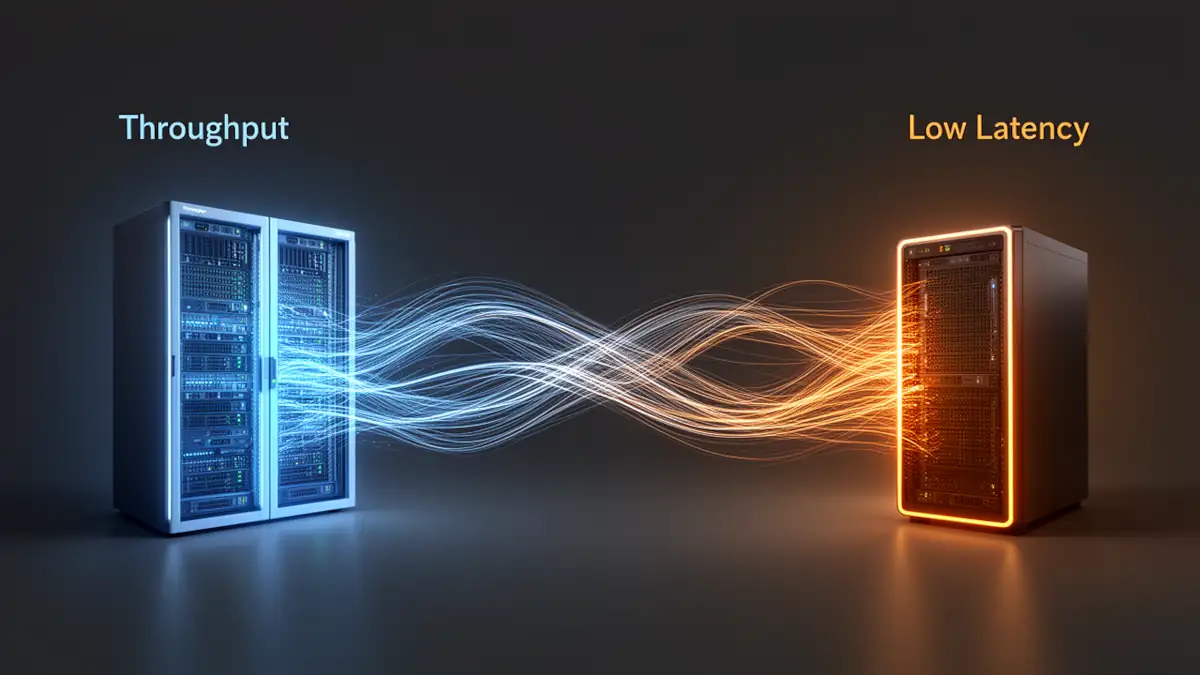
AI inference throughput defines how many tokens per second a system can process under sustained load, while latency measures how quickly a single request receives a response. In 2026, as agentic AI systems execute multi-step workflows and long-context models expand memory demands, the trade-off between throughput and latency has become a primary economic constraint. Understanding this balance is essential for optimizing GPU utilization, controlling inference cost, and scaling infrastructure efficiently.
This shift is closely linked to the broader structural transformation described in our analysis of Agentic AI 2026 and infrastructure expansion, where sustained workloads, not sporadic queries, drive capital allocation.
What Is AI Inference Throughput?
AI inference throughput refers to the rate at which a system can generate or process tokens over time under realistic load conditions. It is typically expressed in tokens per second per GPU, or at cluster scale, tokens per second aggregated across accelerators.
In 2026, this metric has overtaken model size headlines as the primary engineering variable. When agents operate continuously and multiple sessions run in parallel, the question is no longer “how large is the model?” but “how efficiently can the system sustain output?”
Tokens per Second and Batch Processing
Tokens per second depends on several interacting variables:
- Model architecture and parameter count
- Context window length
- Batch size
- GPU memory availability
- Kernel and runtime optimizations
Batching improves hardware utilization by processing multiple requests simultaneously. However, larger batch sizes increase per-request latency. This creates a classic trade-off: higher system-wide throughput versus slower individual responses.
Modern inference servers dynamically adjust batch size based on load conditions. Under high concurrency, adaptive batching can significantly increase tokens per second per GPU, improving cost efficiency.
A simplified representation of system-level throughput can be expressed as:
Throughput ≈ (tokens per second per GPU) × (number of GPUs) × utilization rate
Utilization rate becomes critical. Idle GPUs reduce economic efficiency, while saturated GPUs increase latency and queuing delays.
Latency vs Throughput: Why They Conflict
Latency measures how long a user waits for a response. Throughput measures how much total work the system completes over time. These objectives are often in tension.
Low latency requires smaller batches, aggressive scheduling, and reserved memory for immediate execution. High throughput favors larger batches, longer scheduling windows, and sustained GPU occupancy.
As reported by Reuters in the context of expanding AI infrastructure spending, hyperscalers are scaling capacity to support persistent workloads rather than short-lived interactions. This reflects a strategic pivot toward throughput-driven economics rather than purely latency-optimized chat experiences.
For engineering teams deploying coding agents or workflow automation systems, the trade-off becomes operational. A system optimized for minimal latency may be economically inefficient under sustained multi-agent load. Conversely, a throughput-optimized system may introduce response delays that affect user experience.
Understanding this balance is foundational before moving to hardware-level constraints and cluster density limits.
The Throughput Ceiling: Hardware Constraints
AI inference throughput is not purely a software optimization problem. It is bounded by hardware constraints, particularly GPU memory capacity, memory bandwidth, and interconnect topology.
In 2026, as long-context models and agentic workflows become common, these physical limits increasingly define economic ceilings. Infrastructure spending, including the large-scale AI capex reported by Reuters, reflects an attempt to push those ceilings outward.
GPU Memory and KV Cache Pressure
One of the most significant throughput constraints is GPU memory, particularly VRAM allocated to the model weights and KV cache.
During inference, transformer models store key and value tensors for each processed token. As context length grows, KV cache memory scales approximately linearly with the number of retained tokens. A jump from 128K to 1M tokens, as reported in the case of DeepSeek’s long-context expansion, increases memory requirements substantially.
Higher memory allocation per session reduces:
- Maximum concurrent sessions per GPU
- Effective batch size
- Overall cluster-level throughput
If a single session consumes a large share of VRAM, concurrency drops. Lower concurrency reduces aggregate tokens per second across the cluster, even if single-session latency remains acceptable.
This is why long-context capability must be evaluated not only as a feature upgrade but as a throughput constraint multiplier. The trade-off between memory footprint and concurrency directly influences cost per task.
We analyze these long-context implications more deeply in our article on AI Inference Economics 2026, where memory scaling is tied to capital expenditure and infrastructure density.
Interconnect and Bandwidth Bottlenecks
Beyond single-GPU memory, throughput at cluster scale depends on interconnect bandwidth and communication latency between accelerators.
In multi-GPU inference setups, especially for larger models or sharded deployments, tensor parallelism and pipeline parallelism require frequent synchronization. This introduces overhead:
- Inter-GPU communication latency
- Network bandwidth saturation
- Increased scheduling complexity
High-bandwidth interconnects reduce this penalty, but they do not eliminate it. As cluster size increases, coordination overhead grows, potentially limiting linear scaling.
For sustained agentic workloads, this matters because multi-step execution often involves repeated inference calls across the same model. Even small synchronization inefficiencies can compound under persistent load.
Throughput ceilings therefore emerge from three interacting layers:
- Memory constraints per GPU
- Compute throughput per accelerator
- Communication overhead across the cluster
Infrastructure density decisions must account for all three simultaneously. Adding more GPUs does not guarantee proportional throughput gains if memory fragmentation, interconnect bottlenecks, or scheduling inefficiencies remain unoptimized.
Agentic Workloads and Sustained Load
AI inference throughput becomes significantly more complex when moving from conversational systems to agentic execution. In 2026, many AI deployments are no longer single-turn assistants but multi-step workflow engines.
Agentic systems execute chains of actions: analyze input, retrieve data, generate intermediate outputs, call tools, and iterate. Each step produces additional tokens and often triggers new inference cycles.
Comparative analysis of inference profiles
| Feature | Conversational AI (Legacy) | Agentic AI (2026) | Technical impact |
| Load pattern | Bursty (spikes and idle) | Sustained (continuous execution) | Higher thermal stress and power draw |
| Session duration | Short (seconds) | Persistent (minutes to hours) | High KV cache retention requirements |
| Batching strategy | Static or minimal | Aggressive adaptive batching | Throughput prioritized over raw latency |
| Memory footprint | Low to moderate | Extreme (due to long context) | Limits maximum concurrent agents per GPU |
| Optimization goal | Time to first token (TTFT) | Tokens per second (TPS) per dollar | Shift from UX focus to economic focus |
This table highlights the technical paradox: while the user demands an immediate response, the infrastructure, to remain profitable, must enforce batch processing that prioritizes overall volume over individual speed.
From Prompt-Response to Persistent Sessions
Traditional chat interactions are bursty. A user sends a prompt, receives a response, and the session ends or pauses. GPU utilization fluctuates accordingly.
Agentic workflows behave differently. A single request may trigger:
- Sequential reasoning steps
- Tool invocations
- Intermediate validations
- Structured output generation
These steps extend session duration and increase token accumulation. Instead of short-lived spikes, inference load becomes sustained.
This transition is central to the broader structural shift described in Agentic AI 2026, where workflows increasingly replace static prompts.
Persistent sessions alter the economics of throughput. GPU occupancy rises, idle cycles shrink, and memory remains allocated for longer durations.
Why Throughput Becomes the Real Cost Driver
Under agentic conditions, cost is no longer dominated by price per token alone. It is shaped by:
- Duration of execution
- Concurrency of active agents
- Memory footprint per workflow
- Scheduling efficiency under load
A system that appears inexpensive at low usage may become costly under sustained multi-agent concurrency. As reported by Reuters in coverage of software market volatility tied to AI agents, investors are already factoring in the economic implications of persistent automation.
Throughput becomes the primary cost driver because:
- Higher concurrency increases GPU saturation
- Longer sessions reduce batch flexibility
- Memory pressure lowers maximum parallelism
The result is a new optimization target: maintaining high tokens per second without allowing latency to degrade beyond acceptable thresholds.
This is where inference throughput and latency trade-offs become strategic decisions rather than purely technical tuning parameters.
Optimization Strategies in 2026
As throughput becomes the dominant economic variable, optimization strategies shift from single-request acceleration to sustained system efficiency. In 2026, the challenge is not only to make models faster, but to maintain stable performance under persistent multi-agent load.
Dynamic Batching and Scheduling
Dynamic batching aggregates multiple incoming requests into shared execution windows. Under high concurrency, this improves GPU utilization and increases tokens per second.
However, batching introduces scheduling delays. The system must wait briefly to accumulate compatible requests. If the batching window is too large, latency increases. If it is too small, throughput gains are limited.
Modern inference stacks therefore implement adaptive batching strategies. These dynamically adjust batch size based on current queue depth and latency targets.
This approach attempts to preserve acceptable response times while maximizing cluster efficiency. It becomes particularly important when agents generate chained requests in rapid succession.
Context Window Budgeting
Long-context support introduces memory pressure, as discussed earlier. One optimization strategy involves budgeting context length rather than defaulting to maximum windows.
Instead of allocating a 1M-token window to every session, systems may:
- Cap context length dynamically
- Compress historical tokens
- Drop low-value segments
- Switch to retrieval-augmented generation when appropriate
This reduces KV cache growth and preserves concurrency.
As highlighted in recent reporting on long-context model expansion, increased context capacity can improve capability. But without careful budgeting, it can also degrade throughput.
Balancing context length against memory availability becomes a core systems engineering decision.
When to Prefer RAG Over Long Context
Retrieval-augmented generation, RAG, offers a throughput-efficient alternative to ultra-long context windows.
Instead of storing extensive token history directly in the model’s attention mechanism, RAG retrieves relevant document segments externally. This reduces memory footprint per session and preserves GPU concurrency.
The trade-off is architectural complexity. RAG requires:
- Indexing infrastructure
- Vector databases
- Retrieval latency management
- Consistency controls
For coding agents and structured workflows, RAG can improve efficiency when context reuse is limited. We examine practical execution trade-offs in AI coding agents: the reality on the ground beyond benchmarks.
In high-density clusters, RAG often yields better throughput scaling than unlimited context windows. The decision between long context and retrieval is therefore not purely about capability, but about sustained system economics.
What This Means for CTOs and Infrastructure Teams
AI inference throughput is now a board-level variable. In 2026, infrastructure decisions must account for sustained load, agent concurrency, and long-context memory pressure rather than peak demo performance.
For CTOs, the priority shifts toward predictable throughput under real workloads. GPU procurement decisions should be evaluated not only on theoretical TFLOPS, but on:
- Tokens per second under realistic batch sizes
- Memory capacity relative to expected context length
- Utilization rate under persistent agent workflows
- Interconnect bandwidth in multi-GPU configurations
Cluster density planning must consider how many concurrent agent sessions can be supported before latency begins to degrade. A cluster that performs well in synthetic benchmarks may saturate quickly under chained execution patterns.
Energy consumption also becomes a strategic constraint. Sustained high utilization increases power draw and cooling requirements. As AI workloads become continuous rather than burst-based, infrastructure efficiency and energy optimization directly influence operational margins.
For infrastructure teams, the implication is clear. AI inference throughput and latency trade-offs must be treated as system-level design variables. Model capability, memory configuration, scheduling policies, and hardware topology are interdependent.
AI inference throughput in 2026 is no longer a performance metric alone. It is an economic boundary condition that shapes cost, scalability, and competitive positioning.
FAQ
What is the difference between throughput and latency in AI?
Throughput is the total volume of data (tokens) processed per unit of time, while latency is the time taken to process a single specific request.
Why does long context reduce throughput?
Long context requires storing more data in the GPU memory’s KV cache, which reduces the space available to process other requests in parallel, thereby limiting concurrency.
How do AI agents impact infrastructure costs?
Agents create longer and more complex sessions, keeping GPUs occupied for extended periods and requiring precise bandwidth management to avoid overhead costs.
Your comments enrich our articles, so don’t hesitate to share your thoughts! Sharing on social media helps us a lot. Thank you for your support!