
How to use conversational AI for predictive trend analysis in 2026

Predictive analysis is no longer the exclusive domain of data science teams equipped with complex stacks and custom-built models. In 2026, conversational AI platforms such as ChatGPT, Claude, and Gemini are empowering non-technical leaders to explore trends, stress-test hypotheses, and project scenarios directly from raw datasets.
However, the term “predictive analysis with conversational AI” can be misleading. These tools do not “predict” the future in a deterministic sense. Instead, they orchestrate existing statistical methods, enrich them with qualitative context, and translate them into actionable insights for decision-making. This guide establishes a clear, methodological, and realistic framework for leveraging these tools without falling into the traps of over-promising or interpretative bias.
In this article, “predictive analysis” does not refer to autonomous forecasting models, but to scenario-based projections and statistical reasoning orchestrated through conversational AI.
Understanding the mechanics of conversational AI in predictive analytics
The shift from traditional predictive modeling to AI interfaces
Traditional predictive analytics relies on explicit statistical or probabilistic models: regressions, time-series forecasting, ARIMA models, and supervised machine learning. These approaches require deep technical expertise, specialized computing environments, and expert interpretation.
Conversational AI does not replace these foundations. It acts as an intelligent interface:
- It interprets complex instructions provided in natural language.
- It generates and executes statistical code (e.g., Python) in a sandboxed environment.
- It bridges the gap between quantitative data and qualitative context, such as industry reports or market sentiment.
- It reframes technical outputs into strategic narratives.
Capabilities vs. limitations
A conversational AI agent can:
- Analyze imported time-series data from CSV, Excel, or BigQuery exports.
- Identify structural trends, seasonality, and cyclical patterns.
- Execute standard statistical projections.
- Compare multiple “What-if” hypothetical scenarios.
- Synthesize signals from provided research papers or market reports.
Conversely, it cannot:
- Spontaneously access private internal data without explicit RAG integration.
- Guarantee accuracy if the underlying data is biased or sparse.
- Replace professional judgment or the accountability of a strategic decision.
Projection, prediction, and probabilistic scenarios
A critical distinction must be made between three concepts:
- Projection: The mathematical extrapolation of past trends into the future.
- Prediction: A conditional estimate based on a specific model and set of variables.
- Scenarios: The exploration of multiple possible futures based on explicit parameter shifts.
Conversational AI is most powerful in probabilistic scenario modeling. It allows leaders to test hypotheses and observe potential outcomes rather than seeking a single, deceptively precise value.
A universal framework for reliable AI-driven predictive analysis
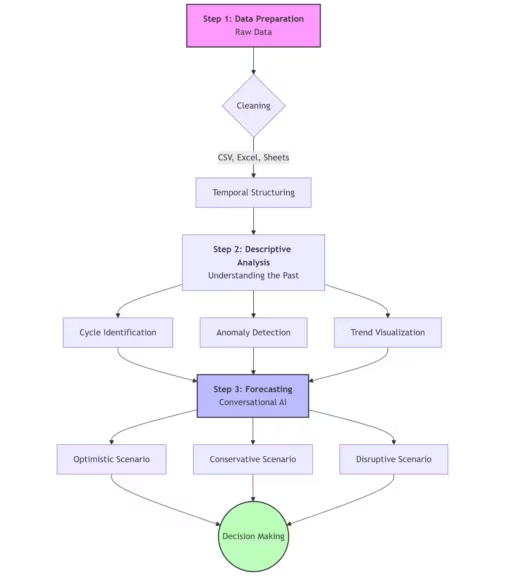
(Click to enlarge)
Step 1 – Data preparation and structuring
Predictive analysis is only as good as its input. AI is not a corrective for poor data quality. Core prerequisites include structured formats, explicit temporal dimensions, and basic data hygiene like handling missing values.
Step 2 – Descriptive analysis and contextualization
Before projecting the future, one must master the past. This stage is often bypassed, yet it dictates the validity of the entire process. AI should be tasked to summarize the global trajectory of KPIs and isolate seasonal cycles from noise.
Step 3 – Predictive projection and scenarios
Once the context is established, the AI can generate or execute statistical models to propose projections. Best practices include:
- Explicitly asking for the model’s underlying assumptions.
- Exploring multiple scenarios, such as optimistic and conservative.
- Integrating contextual variables like market trends or regulations.
- Interpreting results as orders of magnitude rather than absolute certainties.
To apply this method to your specific industry, explore our 5 high-impact business use cases for predictive AI.
Strategic applications summary by domain
| Industry Sector | Predictive Use Case | Executive Benefit | Reliability Indicator |
|---|---|---|---|
| Sales & Inventory | Seasonal cycle analysis and demand planning. | Reduction in overstocking and optimized procurement. | Forecast Accuracy variance between projection and actuals. |
| Customer Success | Identifying signals of attrition (Churn). | Proactive retention campaigns targeting at-risk segments. | Actual churn rate vs. Probabilistic expected scenario. |
| Marketing | Media mix optimization and ROI forecasting. | Agile budget reallocation between acquisition levers. | Variance between AI-projected ROI and measured ROI. |
| E-commerce | Trend detection via sentiment analysis. | Anticipation of unmet needs and product launches. | Conversion rate of newly identified product segments. |
2026 Toolstack: Choosing your predictive engine
Strategic leaders select their conversational AI based on the specific nature of their data architecture:
| Platform | Core Strength | Predictive Sweet Spot |
|---|---|---|
| ChatGPT (Advanced Data Analysis) | Python execution in sandbox | Quantitative forecasting & statistical modeling |
| Claude (Anthropic) | Nuanced reasoning & long context | Qualitative signal detection & strategy auditing |
| Gemini (Google DeepMind) | Multimodal & Workspace integration | Large-scale research & real-time sheet analysis |
ChatGPT: The statistical powerhouse
With its native ability to write and execute code, ChatGPT remains a leader for deterministic analysis. It builds regression models to calculate trajectories rather than just guessing.
- Best for: Processing large .csv exports, generating correlation matrices, and running Monte Carlo simulations.
Claude: The strategic auditor
Claude’s strength lies in its contextual window and lower hallucination rate. When analyzing dense industry reports alongside internal datasets, Claude identifies “weak signals” that purely quantitative models might miss.
- Best for: Scenario planning, cross-referencing market trends with internal audits, and “red-teaming” strategic assumptions.
Gemini: The research librarian
Gemini shines when predictive data is scattered across the Google ecosystem. Its massive context window allows it to “read” an entire repository of past performance files to find long-term cycles.
- Best for: Real-time web-grounded research and collaborative forecasting within Google Sheets.
Advanced workflows: Beyond the basic prompt
To achieve “Cosmo-Edge” level precision, basic prompting is insufficient. Enterprises are moving toward Agentic Workflows and RAG (Retrieval-Augmented Generation).
RAG-Enhanced forecasting
The biggest limitation of general AI is the “knowledge cutoff”. For organizations handling sensitive data, Predictive analytics and RAG provide a secure way to leverage private enterprise information by connecting the AI directly to your proprietary data lake.
- The Result: Highly specific, grounded forecasts that cite internal sources and reduce hallucinations significantly.
Agentic Analysis Loops
In 2026, we utilize AI agents that follow an iterative loop:
- Agent A (The Cleaner): Identifies outliers in your data.
- Agent B (The Analyst): Runs various statistical models.
- Agent C (The Critic): Challenges the models and looks for logical fallacies.
Structural limitations and strategic safeguards
Even the most advanced LLM is subject to algorithmic drift and contextual bias. Understanding the reliability, bias, and measurable limits of AI is mandatory for professional-grade forecasting.
- The “Hallucination of Precision”: An AI might provide a decimal-point-perfect number that is fundamentally wrong. Always treat outputs as probability ranges, not absolute truths.
- Data Silos: Conversational AI is only as good as the context it is fed. If supply chain data is missing from the prompt, the sales forecast becomes irrelevant.
- Privacy & Compliance: Ensure your stack uses Enterprise-grade privacy layers where data is not used for model training (GDPR/AI Act compliance).
Conclusion: From forecasting to decision intelligence
Conversational AI has successfully demystified predictive analytics, turning it into a structured dialogue between human intuition and machine processing power. In 2026, the competitive advantage belongs not to those who have the most data, but to those who know how to interrogate it. By moving from static dashboards to dynamic, scenario-based conversations, leaders can navigate market volatility with unprecedented agility.
Mastering these tools starts with the precision of your instructions. Use our library of advanced prompts for predictive analysis to build your first auditable projections.
FAQ: Conversational AI and Predictive Analytics
Is it secure to use proprietary company data in a conversational AI?
Security depends on the platform version. For sensitive information, you must use Enterprise-grade solutions (ChatGPT Enterprise, Claude for Business) which guarantee that your data is not used for model training. Implementing a RAG architecture for predictive analytics further ensures data remains within a controlled environment.
What is the difference between a prediction and a projection?
A projection is a simple mathematical extrapolation of historical trends. AI-assisted predictive analysis is more complex, cross-referencing data with qualitative hypotheses to create conditional estimations. For a deeper dive into these nuances, consult our guide on AI reliability and limits.
Can conversational AI replace a professional Data Scientist?
No. Conversational AI acts as an exploration accelerator and a brainstorming partner. While it can quickly generate orders of magnitude, industrial-grade modeling and complex data governance still require rigorous human expertise.
Do I need coding skills for predictive analysis in 2026?
No. Conversational AI has removed the coding barrier. By using expert data analysis prompts, you can instruct the AI to execute complex statistical computations (Python, R) on your behalf using natural language.
Your comments enrich our articles, so don’t hesitate to share your thoughts! Sharing on social media helps us a lot. Thank you for your support!