
Conversational AI and predictive analytics: 5 high-impact business use cases

The integration of conversational AI into strategic workflows marks a shift from traditional, reactive Business Intelligence to an agile, anticipatory model. Unlike legacy systems that require complex SQL queries or data science pipelines, conversational interfaces like ChatGPT, Claude, and Gemini allow stakeholders to interrogate datasets using natural language.
However, for the global enterprise, it is crucial to distinguish between exploratory predictive scenarios and production-grade industrial models. We define conversational AI for predictive analysis as a framework for conditional estimation and probabilistic forecasting, rather than an automated replacement for rigorous machine learning validation.
Strategic summary
| Use case | Primary benefit | Reliability indicator (Feedback loop) |
|---|---|---|
| Sales & Inventory | Reduction of overstocking | Forecast accuracy variance |
| Customer Churn | Proactive retention | Actual churn rate vs. Expected scenario |
| E-commerce | Detection of weak signals | Conversion rate of new segments |
| Maintenance | Downtime optimization | Mean Time Between Failures (MTBF) |
| Media Mix | Advertising ROI | Variance between projected and measured ROI |
1. Demand forecasting and inventory optimization
One of the most immediate applications is the synchronization of supply chains with shifting market signals. Conversational AI can ingest historical sales data and cross-reference it with external variables such as logistical lead times, seasonal cycles, or macroeconomic indicators.
By orchestrating these data points, the AI generates conditional projections that enable:
- Reduced carrying costs by identifying potential overstock scenarios before they occur.
- Mitigation of stock-out risks during high-volatility periods.
- Strategic supplier negotiations based on weighted scenarios (conservative, baseline, and aggressive).
2. Customer churn mitigation and retention modeling
In subscription-based economies or SaaS environments, identifying “silent” churn signals is vital for maintaining LTV (Lifetime Value). By processing anonymized behavioral data, conversational AI can surface segments at risk of attrition through a probabilistic lens.
Business leaders can use these tools to simulate the impact of retention initiatives: “If we deploy a targeted feature-adoption campaign for this cohort, what is the expected outcome on our 90-day churn rate?”. It is essential to implement a feedback loop, measuring the variance between these AI-driven projections and actual results to refine future hypothesis testing.
3. E-commerce trend analysis and consumer sentiment
Modern e-commerce generates vast amounts of unstructured qualitative data. Conversational AI excels at synthesizing thousands of customer touchpoints into actionable signals. By leveraging a RAG (Retrieval-Augmented Generation) architecture to connect the AI to your internal knowledge base, companies can bridge the gap between qualitative feedback and transactional data.
This approach facilitates:
- Early detection of unmet market needs before they scale.
- Evaluation of the order of magnitude for potential product iterations.
- Dynamic reallocation of media spend toward emerging high-growth categories.
4. Industrial maintenance and operational interface
High-fidelity predictive maintenance continues to rely on dedicated industrial systems (MES, SCADA, and edge analytics platforms processing IoT sensor streams). In this context, conversational AI does not replace these models but functions as an interpretation, restitution, and interaction layer, translating complex telemetry into decision-ready insights for operational teams.
By analyzing incident logs and maintenance history, the AI suggests optimal intervention windows. This helps stakeholders visualize the trade-off between immediate maintenance costs and the financial risk of catastrophic failure, acting as a decision-support tool rather than an autonomous explicit predictive model.
5. Marketing attribution and media mix modeling (MMM)
Marketing executives use conversational AI to project the ROI of cross-channel campaigns. By ingesting historical performance data, the AI identifies attribution patterns and channel efficacy across different seasonal windows.
This allows for virtual “stress-testing” of the marketing budget: “What is the conditional projection if we shift 15% of our top-of-funnel spend to lower-funnel conversion channels?”. The output provides a strategic order of magnitude that informs, but does not replace, the final human decision.
FAQ: Enterprise predictive use cases
Is it secure to process proprietary data through conversational AI?
Security is a matter of architecture. While consumer-grade models may use data for training, Enterprise-tier solutions (e.g., ChatGPT Enterprise, Claude for Business) offer strict data governance, ensuring your inputs are never used for model optimization. For European operations, alignment with GDPR and AI Act frameworks is mandatory.
Can conversational AI effectively “predict” market crashes or black swans?
No. Conversational AI provides conditional estimations based on historical patterns and provided variables. It is a tool for navigating uncertainty through scenarios, not a “crystal ball” for unpredictable global disruptions.
What is the minimum data threshold for reliable projections?
For robust forecasting, a minimum of 18 to 24 months of historical data is recommended. This allows the model to differentiate between true seasonal cycles and statistical noise or outliers.
A strategic compass for the data-driven era
(Click to enlarge)
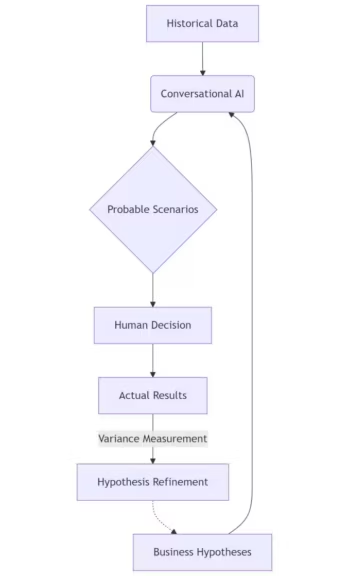
AI-Augmented Decision-Making Framework This diagram highlights the role of Conversational AI as a strategic orchestration layer. By ingestion of Historical Data combined with specific Business Hypotheses, the AI generates Probable Scenarios that inform the final Human Decision. This framework emphasizes the “Feedback Loop”: by performing a Variance Measurement between actual results and AI projections, organizations can continuously refine their predictive hypotheses and improve overall decision accuracy.
Conversational AI should be viewed as a strategic compass, not an oracle. It transforms raw data into executable narratives, moving organizations from a reactive stance to a culture of anticipation through structured scenario planning.
To achieve higher precision and security, integrating RAG (Retrieval-Augmented Generation) is the next logical step, allowing for deep interrogation of internal documents without compromising data integrity. Are you ready to explore how predictive RAG frameworks can secure your competitive advantage in 2026?
Your comments enrich our articles, so don’t hesitate to share your thoughts! Sharing on social media helps us a lot. Thank you for your support!