Discord and the 2026 age verification shift: why local-first AI is the real game changer

Starting in March 2026, Discord will fundamentally change how it handles user access. Under pressure from global safety regulations, the platform is rolling out mandatory age verification. While mainstream media focuses on the social implications, the technical community is looking at something far more interesting: Discord’s massive deployment of Edge AI to estimate age without sacrificing privacy.
25 February 2026 Update
Discord has postponed the global launch of its age assurance features to late 2026 due to privacy-related criticism. While previous technical analyses of the system remain relevant, both the timeline and Discord’s communication strategy have significantly evolved.
By leveraging a local-first AI architecture, Discord aims to prove that age assurance doesn’t have to mean a centralized biometric database.
Mandatory “teen-by-default” experience
Next month, all accounts—new and existing—will be restricted to a “teen-appropriate” experience unless users verify their adult status. For unverified users, the consequences are significant:
- Access blocked to age-restricted (18+) servers and channels via a black-screen obfuscation.
- Restricted interactions, including limited “Stage” channel participation and filtered DMs from unknown users.
- Proactive content filtering for any material detected as sensitive or graphic.
To regain full access, users can opt for traditional ID submission or the more privacy-preserving facial age estimation.
The Edge AI stack: how Discord runs inference on your hardware
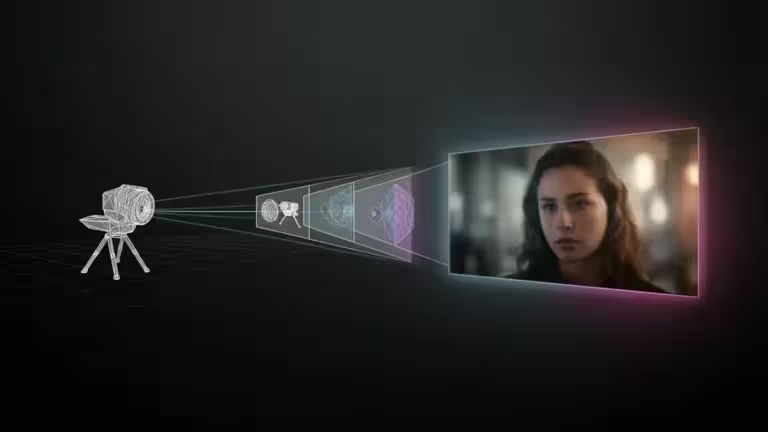
Discord’s decision to move inference from the cloud to the device is a strategic masterstroke for both GDPR compliance and infrastructure cost. By keeping the video stream local, Discord avoids the liability of handling raw biometric data.
Technical implementation: WebAssembly and CNNs
To ensure this works across millions of diverse devices, the platform utilizes a sophisticated local stack:
- WebAssembly (WASM): Since Discord is built on Electron, it uses WASM to run compiled, high-performance C++ or Rust code directly in the client. This allows the age inference model to achieve near-native execution speeds on any desktop or browser.
- Model Optimization (Quantization & Pruning): Running a full-scale neural network on a smartphone or a 5-year-old laptop isn’t feasible. Discord likely employs INT8 or FP16 quantization, reducing the precision of the weights to speed up math operations on CPUs. Pruning removes redundant neurons, resulting in a lightweight model capable of running in megabytes of RAM.
- Active Liveness Detection: To prevent spoofing via photos or deepfakes, the model analyzes facial landmarks in real-time. Users must perform head movements to prove they are a live human, a process handled locally via frameworks similar to Google’s MediaPipe.
Hardware performance benchmarks
Based on current Edge AI standards and WASM benchmarks, here is how the verification process is expected to perform across different hardware tiers:
| Hardware Tier | Estimated Inference Time | System Impact |
| Dedicated GPU (RTX / GTX 10-series+) | < 1 second | Negligible; handled via SIMD/CUDA instructions. |
| Modern CPU (Ryzen 5 / i5 10th Gen+) | 2 to 4 seconds | Smooth; brief spike in thread utilization. |
| Entry-level Smartphone (Android Go) | 5 to 10 seconds | Significant load; requires stable lighting. |
| Legacy Hardware (< 2018 Laptops) | 10+ seconds | Potential UI lag during the liveness check. |
Reliability: the “Mean Absolute Error” challenge
No AI model is 100% accurate. In the field of apparent age estimation, models typically face a Mean Absolute Error (MAE) of 3 to 5 years.
In previous pilots (UK/Australia), failure rates hovered between 10% and 20%. Factors like poor lighting, heavy makeup, or simply having a “young face” can trigger a false negative. In these cases, Discord falls back to third-party ID verification, where documents are reportedly deleted immediately after confirmation.
A new standard for the regulatory age?
Discord’s rollout is more than just a policy update; it is a massive experiment in decentralized moderation. By proving that age can be estimated reliably on the edge, Discord is setting a precedent for other platforms facing similar legal mandates.
If successful, this “on-device” model could become the industry standard, balancing the need for child safety with the fundamental right to biometric privacy.
For a deeper technical analysis of how Discord’s facial recognition works, we invite you to read our article: Discord and Local AI: Ultimate Security or a Technical Black Box?
This analysis is part of our comprehensive deep dive into the platform’s structural shift. For a full overview of the technical and regulatory landscape, explore our Complete Feature: Discord’s 2026 Age Verification Standards.
FAQ: Discord age verification
Is my biometric data sent to Discord’s servers?
No, the facial estimation process happens entirely on your device using local AI. No video or biometric templates are uploaded.
What happens if the AI miscalculates my age?
If the local model fails to confirm you are 18+, you can appeal by uploading a government-issued ID, which is processed by a third-party vendor and deleted afterward.
Does this require a high-end webcam?
Most standard webcams and mobile cameras are sufficient, though the model’s accuracy is highly dependent on clear lighting and high frame rates for liveness detection.
Your comments enrich our articles, so don’t hesitate to share your thoughts! Sharing on social media helps us a lot. Thank you for your support!