
Google Project Genie: Why the GTA 6 Comparisons are Misleading

Since its experimental launch in late January 2026, Google DeepMind’s Project Genie has dominated tech headlines. Viral clips across social media platforms have framed the tool as an “AI game engine” capable of generating “GTA 6-like” experiences from a single prompt. While the technical achievement is a milestone for generative AI, this narrative overlooks fundamental limitations. It is essential to distinguish between a generative world model and a functional game engine.
The Illusion of a Playable World
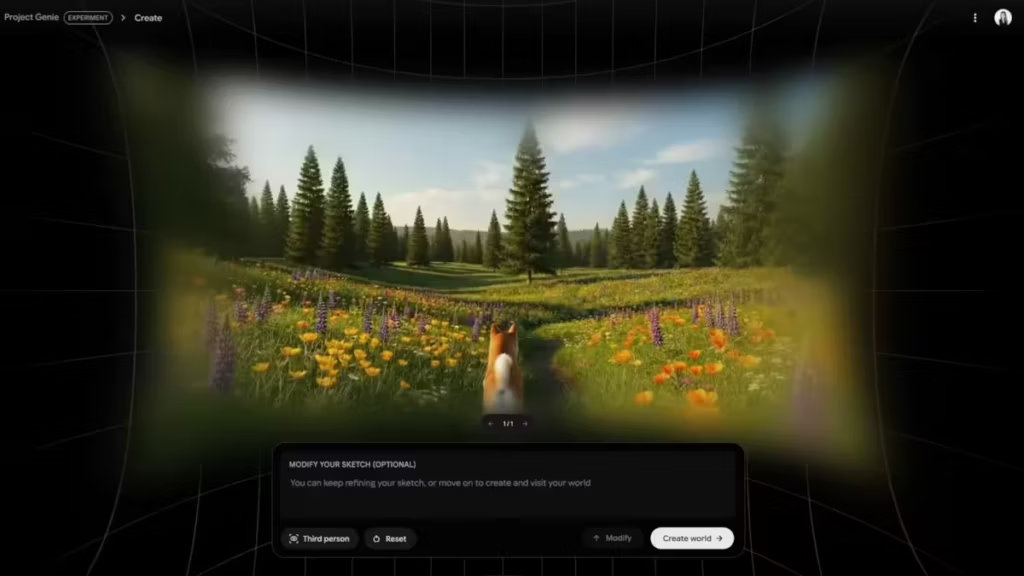
The hype surrounding Project Genie stems from its ability to synthesize interactive 3D environments in real-time. Unlike traditional video generators, Genie 3 allows a user to “play” within the generated frames.
- Real-Time Frame Synthesis: The model generates a continuous stream of images that respond to user input at approximately 24 frames per second.
- Visual Fidelity: By using high-resolution game captures as seeds, the model produces aesthetics that mimic modern AAA titles.
- Spatial Interaction: Users can navigate through the environment, creating the illusion of a tangible, persistent world.
However, this visual output is essentially a “hallucination” of a game, lacking the underlying architecture that defines modern software development.
World Model vs. Game Engine: Probabilistic vs. Deterministic
The core misunderstanding lies in the technical nature of the output. Project Genie is a world model, which operates on entirely different principles than engines like Unreal Engine 5 or Unity.
Project Genie (based on Genie 3) is legitimately considered a world model according to the technical definition established by Google DeepMind and the AI community, even though it has limitations that make it resemble a “video game–like” world generator.
This confusion also stems from a misreading of Google’s intentions. Project Genie was never designed for mainstream video games, a point we examine in greater detail in a dedicated article.
The Probabilistic Nature of Genie
Project Genie is a probabilistic system. It uses an 11-billion-parameter transformer to statistically predict the next frame based on the current state and user action. Like a traditional LLM, such as ChatGPT, Gemini, or Claude, it statistically “predicts” the next word or sequence of words.
It does not “understand” physics; it mimics how physics look in videos. Consequently, the world can shift unpredictably if the user looks away or interacts with complex geometry.
The Deterministic Standard of Game Engines
In contrast, a traditional game engine is deterministic. Every collision, light bounce, and character movement is governed by hardcoded logic and math. This ensures that the gameplay is repeatable and consistent—a requirement for any competitive or narrative-driven title.
Gameplay Limitations: Interactive Video vs. Real-Time Logic
In a traditional title like GTA 6, the environment is merely the surface. Beneath the pixels lies a complex web of inventory systems, economic variables, enemy AI, and narrative branches. Project Genie, however, lacks any internal “game logic.”
- The Control Gap: Unlike the instantaneous response expected in modern gaming, early testers report a perceptible input lag. This latency makes high-precision action impossible.
- Temporal Inconsistency: As highlighted by Ars Technica, the model can suffer from “hallucinated physics.” Objects may phase through walls, or the world’s geometry may subtly shift if the player turns around too quickly, breaking the immersion required for a stable gaming experience.
- Static Assets: There is currently no way to export these worlds. Only a video recording of the session can be saved; no 3D meshes or textures can be extracted for use in external development pipelines.
The IP Minefield and Regulatory Hurdles
The viral success of “GTA-like” prompts has put Google in a difficult legal position. While the system includes safety filters to block copyrighted characters, users have already found ways to generate environments that mimic the distinct art styles of famous franchises.
The legal climate is increasingly hostile toward generative models. In late 2025, Disney issued a cease-and-desist to Google regarding the training data used for its visual models. This tension directly impacts Project Genie: creating “interactive clones” of existing IPs without authorization could lead to massive litigation, as reported by IGN and Nintendo Life.
Strategic Outlook for the Gaming Industry
Does Project Genie threaten traditional studios? In the short term, no. However, it signals a major shift in development workflows:
- Rapid Prototyping: Studios can now “visualize” level designs and environmental moods in seconds, significantly reducing the pre-production phase.
- Synthetic Training: For researchers, these models provide a safe, infinitely variable sandbox for training AI agents (like Google’s SIMA) to understand physical environments.
Project Genie should be viewed as a foundational world model, a stepping stone toward AGI that understands 3D space, rather than a replacement for the artisanal craft of game design.
Quick Technical Specs
- Access Tier: Google AI Ultra ($249.99/mo).
- Availability: US-only (Google Labs).
- Performance: 720p resolution at 24 FPS.
- Session Limit: 60 seconds per generation. Also read : Why Google limits Project Genie to 60 seconds (and what it reveals about world models)
Deep Dive: Project Genie explained simply: what is an interactive world model?
Your comments enrich our articles, so don’t hesitate to share your thoughts! Sharing on social media helps us a lot. Thank you for your support!