Weekly AI highlights for November 24–29: Claude 4.5 reasoning leap, FLUX 2 4-MP imaging, DeepSeek Math V2, and GPT 5.1 now in Windows 11 Copilot.
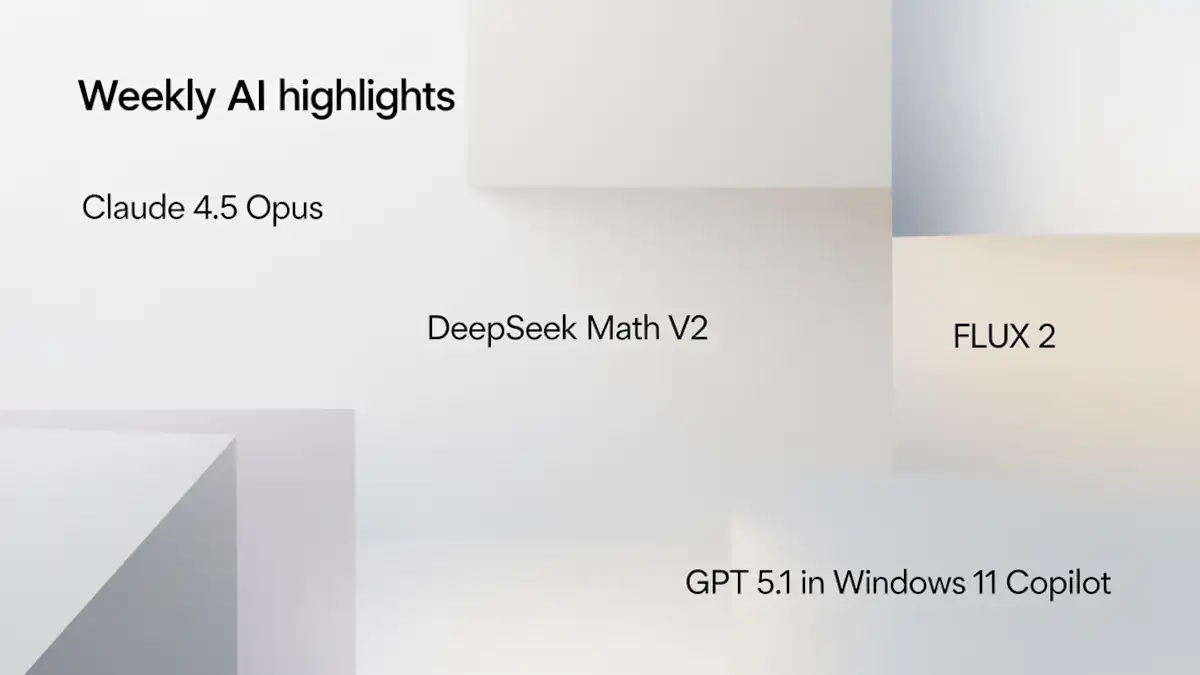
The pace of artificial intelligence continues to accelerate, and late November (24 to 29) 2025 highlights a striking contrast between rapid innovation and mounting pressure on the infrastructure that powers it. Claude Opus 4.5 pushes reasoning benchmarks to new highs, FLUX.2 expands the frontier of image generation, DeepSeek releases an open source math model approaching olympiad-level accuracy, and GPT 5.1 brings advanced capabilities to Windows 11 Copilot at no additional cost. This page covers AI news from November 24–29, 2025.
Find the latest weekly AI news on our main page, updated regularly.
These announcements arrive at a decisive moment. Demand for AI is surging, professional GPUs remain under heavy strain, and many users are beginning to notice intermittent slowdowns in popular services. To cope with this pressure, vendors are leaning on software-level optimizations, more efficient model architectures, and techniques such as adaptive routing, now essential to lowering inference costs while expanding real-world use cases.
This briefing breaks down the key AI developments of the week in a clear, practical format for mainstream readers, enthusiasts, developers, and professionals navigating an industry evolving at full speed.
This Week’s Key AI Announcements at a Glance
The past seven days brought meaningful progress across open source and commercial ecosystems. Anthropic pushed reasoning performance forward with Claude Opus 4.5, Black Forest Labs advanced image generation with FLUX.2, DeepSeek released a mathematically rigorous open source model, and Microsoft broadened access to advanced reasoning inside Windows. These developments reflect a sector balancing innovation with growing pressure on GPU availability and inference stability.
Summary of the Four Major Launches
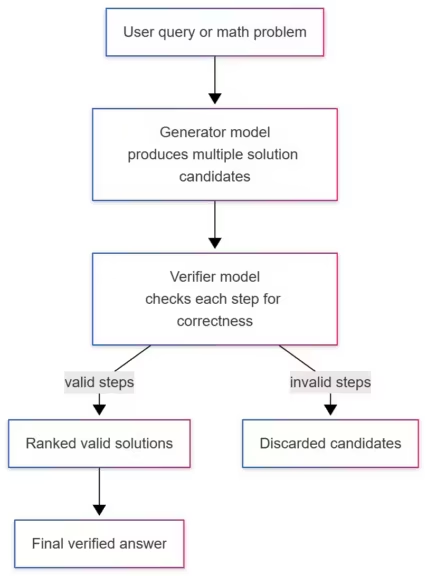
Claude Opus 4.5 surpassed 80 percent on SWE Bench, marking a milestone in automated software engineering. FLUX.2 expanded to 4 MP output with improved style consistency and multi-reference control. DeepSeek Math V2 approached olympiad-level reasoning using a verifier–generator architecture. GPT 5.1 arrived in Windows 11 Copilot with free access to deeper reasoning and multimodal tools.
| Model / Announcement | Release Date (Week of Nov 22–29, 2025) | Key Performance Improvements | Primary Use Cases |
|---|---|---|---|
| Claude Opus 4.5 | November 2025 | Stronger reasoning, better long-context accuracy | Advanced reasoning tasks, coding, research |
| FLUX.2 | November 2025 | Higher image quality, better consistency, improved control | Image generation, creative workflows |
| DeepSeek Math Model (Open Source) | November 2025 | Olympiad-level math reasoning, fast inference | Education, research, symbolic reasoning |
| GPT-5.1 in Windows 11 Copilot | November 2025 | Faster responses, improved tool use, free advanced features | Everyday productivity, writing, code assistance |
Additional Industry Pressure, GPU Constraints and User Slowdowns
These announcements arrive during persistent GPU shortages affecting major cloud providers. As reported in multiple infrastructure analyses, demand for compute continues to outpace supply, resulting in intermittent service slowdowns for widely used systems such as ChatGPT, Claude, and Gemini. This tension underscores the importance of inference-efficiency improvements, compression strategies, and adaptive routing techniques that help maintain responsiveness under heavy load. It also frames this week’s updates as part of a broader effort to scale capability while managing infrastructure limits.
Also read : ChatGPT Timeline Explained: Key Releases from 2022 to 2025
Claude Opus 4.5, Performance Gains and Lower Costs
Anthropic introduced Claude Opus 4.5 with substantial improvements across reasoning and code handling. The model’s strong benchmark results indicate more consistent performance on complex tasks, making it a competitive option for developers and organizations seeking dependable automated assistance. Combined with lowered pricing, Opus 4.5 reflects a shift toward more affordable high-end reasoning models.
Benchmark Improvements, SWE-Bench and ARC-AGI-2
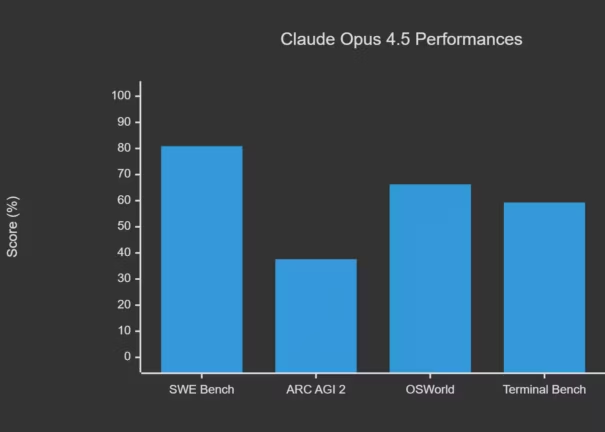
Claude Opus 4.5 recorded 80.9 percent on SWE Bench, becoming the first model to cross this threshold. It performed at 37.6 percent on ARC-AGI-2 and showed steady gains on OSWorld and Terminal Bench, indicating improved generalization across constrained reasoning tasks. These results demonstrate advances in code understanding, problem decomposition, and step-wise logical consistency.
Developer Impact, Debugging, Code Reasoning
For developers, these improvements translate into more reliable debugging assistance, clearer explanations of complex pull requests, and stronger support for multi-step logic. Claude Opus 4.5 also reduces the number of tokens needed for many workflows, lowering inference cost and lag. Teams relying on automated suggestions in CI pipelines or code review processes may see greater stability in tasks involving unconventional edge cases.
Pricing Shifts, Cost Efficiency and Competitive Pressures
Anthropic reduced Opus-tier pricing to 5 dollars per million input tokens and 25 dollars per million output tokens. This change makes large-scale deployments more feasible for teams managing cost-sensitive workloads. It also intensifies competition among high-end reasoning models as organizations evaluate cost-to-performance ratios across commercial offerings.
Also read : DFloat11 : Lossless BF16 Compression for Faster LLM Inference
FLUX.2, Advances in 4MP Image Generation and Multi-Reference Control
Black Forest Labs released FLUX.2, a significant upgrade that enhances image fidelity, stylistic consistency, and reference-guided control. The model builds on the strengths of its predecessors while adding technical refinements that appeal to design teams, content creators, and production pipelines.
Creative Capabilities, 4MP Output and Style Consistency
FLUX.2 introduces 4 MP outputs capable of sharper details, cleaner textures, and more stable compositions. Its improved multi-reference system supports up to ten input images, giving creators greater influence over style, character consistency, and scene structure. Enhanced typography handling also produces cleaner type layouts, a notable improvement for design workflows.








Nvidia FP8 Optimization Pipeline and ComfyUI Integration
The FLUX.2 DEV model (released as Open Weights and therefore free to use) integrates Nvidia’s FP8 precision format along with a weight-streaming pipeline optimized for RTX-class GPUs. These optimizations significantly accelerate inference and reduce memory usage, making 4 MP generation workflows feasible on high-end consumer hardware. Its open-weight design also enables seamless integration with tools like ComfyUI, where users can build structured, reproducible pipelines suitable for experimentation, advanced tuning, and professional-grade iteration.

Professional Use Cases, Production and Previsualization
Creative agencies can use FLUX.2 for faster previsualization, producing multiple stylistic variants while maintaining coherence across sequences. Illustrators benefit from greater control over character consistency, while marketing teams can generate design alternatives rapidly without compromising fidelity. These improvements position FLUX.2 as a practical component in modern visual production toolchains.
DeepSeek Math V2, Open Source Model with Competition-Level Accuracy
DeepSeek introduced Math V2, an open source model optimized for advanced mathematical reasoning and formal problem solving. Its performance rivals high-ranking participants in math competitions, and its verifier–generator architecture enhances reliability in step-wise reasoning tasks.
High-Level Academic Performance, Putnam, IMO, MiniF2F
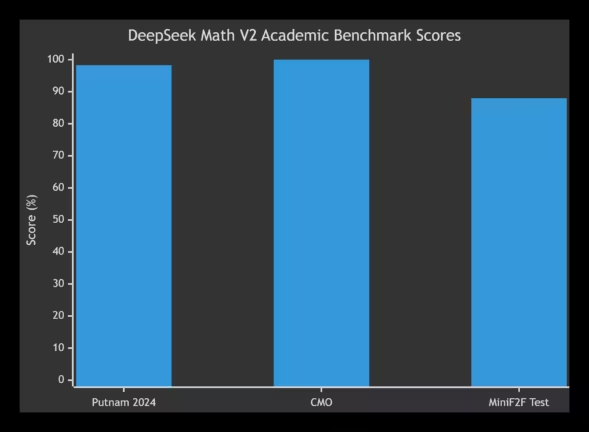
The model demonstrated near-competition-level accuracy, scoring 118 out of 120 on Putnam-style tests and solving multiple IMO-equivalent problems. It achieved more than 88 percent accuracy on MiniF2F, outperforming previous open source math-centric systems. These results reflect a depth of reasoning uncommon in freely available models.
Also read : Doing Math with AI: The Best Formats and Tools to Know
Verifier–Generator Architecture and Reliability
Math V2 uses a two-stage architecture, where a generator proposes solutions and a verifier evaluates each step for correctness. This approach reduces hallucination risk and improves consistency across multi-step derivations. For research, teaching, and symbolic reasoning applications, the architecture provides a transparent and trustworthy pipeline.
Implications for Researchers and Technical Education
Researchers gain a flexible platform for experimenting with formal reasoning and mathematical proof generation. Educators can use the model to create graded examples or step-wise explanations for complex problems. Developers working on systems requiring formal verification may benefit from integrating Math V2 into logic-driven workflows.
GPT 5.1 Comes to Windows 11 Copilot, Free Advanced Features
Microsoft expanded Windows 11 Copilot with the rollout of GPT 5.1, broadening access to deeper reasoning and multimodal features. By exposing advanced capabilities without a subscription, Microsoft strengthens Windows as a default environment for everyday AI-assisted productivity.
Free Access to Thinking Mode, Complex Query Reasoning
GPT 5.1 brings free access to Thinking Mode, enabling richer responses for multi-step queries, document interpretation, research tasks, and creative ideation. This upgrade narrows the gap between free and premium reasoning tiers, giving users a more capable assistant integrated at the OS level.
Copilot Labs, Vision, 3D, Audio and Portrait Tools
The update adds Copilot Labs, a collection of multimodal tools accessible through Windows. Vision inside the app captures and analyzes screenshots or images. A 3D module generates basic objects for creative or prototyping tasks. Audio tools offer transcription and sound analysis. A Portraits tool generates stylized visuals for user profiles or creative projects. Some features load in the browser while others run within Windows for smoother interaction.
Microsoft’s Competitive Position, Hybrid Compute Strategy
Microsoft’s hybrid strategy blends device-level processing, cloud inference, and deeper reasoning capabilities. Free access to GPT 5.1’s advanced mode differentiates Windows from ecosystems that restrict similar features behind paywalls. The approach also helps distribute load during peak usage, a relevant advantage amid ongoing GPU shortages and rising inference demand.
What These Updates Mean for Developers and Mainstream Users
The combined releases point to a broader trend of improving performance, reducing inference costs, and expanding accessibility. Developers benefit from more efficient debugging, math modeling, and pipeline automation, while consumers gain new ways to integrate AI into routine tasks.
Developer Benefits, Efficiency, and Cost-Aware Workflows
Claude Opus 4.5’s reasoning improvements deliver more stable outputs in pull request review and automated analysis. DeepSeek Math V2’s verifier–generator structure offers a reliable foundation for logic-heavy tasks or formal reasoning. FLUX.2’s improved efficiency reduces GPU load for high-resolution visuals, making creative iteration more affordable. Together, these updates support cost-aware development practices by reducing reliance on high-tier cloud instances.
Mainstream Impacts, Accessibility, Integration and Everyday Use
Users benefit from GPT 5.1’s expanded reasoning mode and broader multimodal toolkit, enabling tasks such as summarizing documents, troubleshooting instructions, or creating visual assets with minimal friction. FLUX.2 lowers the barrier to high-quality image generation by offering predictable styling even for non-experts.
| User type | Concrete use cases | Benefits |
|---|---|---|
| Mainstream users | Summarizing documents, drafting emails, troubleshooting instructions, generating simple images, desktop assistance via Windows Copilot | Faster everyday tasks, accessible AI tools, minimal learning curve |
| Creative users | Producing high-quality visuals with FLUX.2, generating presentation assets, experimenting with styles and layouts | Higher image fidelity, consistent styling, rapid iteration |
| Developers | Debugging with Claude 4.5, automated code review, reasoning over multi-step logic, verifying math solutions with DeepSeek Math V2 | More reliable suggestions, reduced development time, stronger step-by-step consistency |
| Researchers | Formal reasoning, math problem solving, verifying intermediate steps, modeling complex hypotheses | Transparent workflows, higher accuracy, reproducible reasoning |
| Professional teams | Workflow automation, content pipelines, previsualization, integrating GPT 5.1 into productivity environments | Lower inference cost, scalable processes, hybrid compute advantages |
Frequently Asked Questions, AI in 2025
What Are the Key AI Developments This Week?
This week’s major updates include Claude Opus 4.5’s benchmark improvements, FLUX.2’s 4 MP image output and multireference features, DeepSeek Math V2’s olympiad-level reasoning, and GPT 5.1’s integration into Windows 11 Copilot with free access to advanced reasoning. These advancements span reasoning, multimodal generation, math modeling, and everyday productivity tools.
How Is AI Advancing in 2025?
AI progress in 2025 reflects three parallel trends, stronger reasoning models, richer multimodal capabilities, and improved inference efficiency. Open source projects such as DeepSeek Math V2 complement commercial releases, while hybrid compute strategies help manage GPU shortages. The ecosystem is moving toward higher reliability and deeper integration across operating systems and professional tools.
Which AI Model Performs Best Right Now?
Performance varies by task. Claude Opus 4.5 leads on reasoning and software-engineering benchmarks. FLUX.2 stands out for style-consistent, high-resolution image generation. DeepSeek Math V2 excels in formal math reasoning. GPT 5.1 offers strong general-use reasoning but prioritizes accessibility and system integration, like Windows 11 Copilot integration, over pure benchmark performance.
What to Watch Next
This week’s announcements highlight an industry accelerating on every front, yet operating under mounting pressure from underlying compute constraints. GPU availability remains one of the most important limiting factors in AI deployment, and the effects are increasingly visible in production systems. Many users now experience slower responses during peak hours as demand continues to outpace the capacity of large-scale data centers. This imbalance is shaping how new models are designed and how companies prioritize optimization.
Inference cost has become a central strategic concern. Enterprises want to integrate AI into more workflows, automate sophisticated tasks, and build agentic systems without absorbing cloud bills that grow faster than the value created. As a result, vendors are investing heavily in two parallel directions, improving hardware efficiency where possible and reducing the computational footprint of models through software-level optimizations. Techniques such as DFloat11 lossless compression, advanced quantization pipelines, and more efficient attention mechanisms are becoming essential to maintain responsiveness under heavy load.
Model developers are also rethinking internal architectures to minimize unnecessary compute usage. Adaptive routing, now used in several cutting-edge systems, illustrates this shift. By dynamically selecting the right model variant depending on task complexity, these systems reduce reliance on the most expensive inference paths while maintaining overall capability. This approach not only lowers operational costs but also improves throughput during periods of high traffic, a growing necessity as user adoption continues to expand.
Looking ahead, the next wave of innovation may center on balancing performance with efficiency. Open source initiatives are accelerating, GPU-oriented optimizations are intensifying, and multimodal systems are gaining resolution and reliability. The pressure on infrastructure is unlikely to ease in the short term, so the key question for the coming months will be how vendors reconcile rapid innovation with the need to deliver stable, cost-effective, and scalable AI services across both professional and mainstream use cases.
Also read :
- Understanding Google TPU Trillium: How Google’s AI Accelerator Works
- Why AI Models Are Slower in 2025: Inside the Compute Bottleneck
Archives of past weekly AI news
- AI News – Highlights from November 14–21: Models, GPU Shifts, and Emerging Risks
- AI Weekly News – Highlights from November 7–14: GPT-5.1, AI-Driven Cyber Espionage and Record Infrastructure Investment
- AI Weekly News from November 7, 2025: OpenAI , Apple and the Race for Infrastructure, Archive
- AI News from Oct 27 to Nov 2: OpenAI, NVIDIA and the Global Race for Computing Power
- AI News: The Major Trends of the Week, October 20–24, 2025
- AI News – October 15, 2025: Apple M5, Claude Haiku 4.5, Veo 3.1, and Major Shifts in the AI Industry
Sources and references
Tech media
- The Verge, reporting on Microsoft’s Copilot updates https://www.theverge.com/
- Wired, analysis on AI industry trends https://www.wired.com/
- Ars Technica, coverage on model performance and GPU constraints https://arstechnica.com/
Companies
- Anthropic, Claude 4.5 benchmark and pricing details https://www.anthropic.com/
- Black Forest Labs, FLUX.2 release information https://blackforestlabs.ai/
- DeepSeek, Math V2 open source documentation https://www.deepseek.com/
- Microsoft, Windows 11 Copilot and GPT 5.1 updates https://www.microsoft.com/
Institutions
- Putnam Competition, benchmark references for math reasoning https://kskedlaya.org/putnam-archive/
- IMO Foundation, competition-level evaluation context https://www.imo-official.org/
Official sources
- Windows 11 Copilot documentation, detailed feature notes https://support.microsoft.com/
- Nvidia technical documentation, FP8 optimization and GPU pipelines https://docs.nvidia.com/
- GitHub repositories, verifier–generator architectures and evaluation tools https://github.com/
Your comments enrich our articles, so don’t hesitate to share your thoughts! Sharing on social media helps us a lot. Thank you for your support!