AI News from Oct 27 to Nov 2: OpenAI, NVIDIA and the Global Race for Computing Power

Between record-breaking finances, industrial alliances and scientific advances, the week of October 27 to November 2, 2025 confirmed America’s dominance in artificial intelligence. From the Department of Energy’s supercomputers to OpenAI’s massive partnerships, the race for computing power has become the core battlefield of global technology.
Find the latest weekly AI news on our main page, updated regularly.
A week dominated by the race for computing power
Click to enlarge
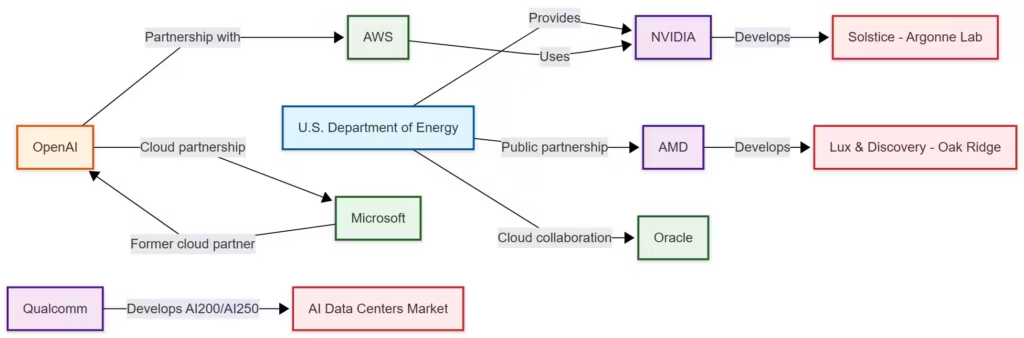
AMD and the Department of Energy: two sovereign AI supercomputers
On October 27, 2025, AMD and the U.S. Department of Energy (DOE) announced a $1 billion partnership to build two new AI supercomputers. The Lux and Discovery systems, located at Oak Ridge National Laboratory (Tennessee), are part of the U.S. strategy for computational sovereignty.
According to Reuters and The Verge, Lux, expected in early 2026, will use AMD MI355X accelerators (1,400 W per card) and deliver three times more power than the DOE’s current systems.
Discovery, based on the upcoming MI430 series, will launch in 2028 and become fully operational in 2029.
NVIDIA and Oracle: 100,000 GPUs for the Solstice project
On October 28, NVIDIA and Oracle unveiled Solstice, a new AI supercomputer designed for the DOE and hosted at Argonne National Laboratory (Illinois).
As reported by NVIDIA and the University of Chicago, the system will deploy 100,000 Blackwell GPUs, along with the Equinox cluster (10,000 GPUs) expected in the first half of 2026.
Together, both infrastructures should reach 2,200 exaflops of computing power, dedicated to research in health, materials, energy and national security.
Computational sovereignty becomes a geopolitical issue
These projects reflect Washington’s ambition to strengthen technological independence amid global competition. The public-private model between the DOE, AMD, NVIDIA, and Oracle aims to preserve U.S. leadership in high-performance computing (HPC), a field crucial for defense and science.
As noted by The Verge, computing power has become both a strategic weapon and a scientific tool.
NVIDIA surpasses $5 trillion: the hardware dominance of AI
A historic valuation driven by Blackwell and Rubin chips
On October 29, 2025, NVIDIA became the first company in history to reach a $5 trillion market capitalization, with shares closing between $207.85 and $207.86, according to Reuters and CNBC.
This record growth is fueled by its Blackwell and Rubin chip families, which represent more than $500 billion in projected revenue through 2026, according to Morningstar.
Artificial intelligence anchored in hardware
The year 2025 confirms a shift: the value of artificial intelligence now lies in computing hardware. GPUs form the backbone of all AI models, from proprietary to open-source, whether in the cloud or running locally on NPU-powered PCs.
This dependency places NVIDIA at the center of the AI ecosystem, while AMD and Qualcomm try to expand its boundaries.
A fragile global dependency
Most tech giants — Microsoft, Amazon, Meta, OpenAI — rely almost entirely on NVIDIA GPUs. As CNBC highlights, this creates a systemic vulnerability: any supply chain disruption could slow down global AI production.
This concentration raises concerns as nations attempt to diversify their sources of computing power and ensure AI sovereignty.
OpenAI and AWS: a $38 billion strategic partnership
OpenAI ends its exclusivity with Microsoft
On November 3, 2025, OpenAI and Amazon Web Services (AWS) announced a $38 billion deal over seven years, according to Reuters.
This partnership ends OpenAI’s exclusive reliance on Microsoft Azure and grants access to hundreds of thousands of H200 and GB200 GPUs hosted on AWS.
As Le Monde reports, full capacity should be available by the end of 2026, with potential extensions through 2027.
Amazon returns to the forefront of AI cloud computing
For Amazon, this partnership reestablishes AWS as a direct competitor to Azure and Google Cloud. The announcement led to a $140 billion increase in Amazon’s market value, while Microsoft shares slightly declined, according to Reuters.
This realignment confirms the escalating rivalry among cloud computing giants in the AI infrastructure race.
The energy question: 30 gigawatts to power AI
CEO Sam Altman stated that OpenAI plans to invest $1.4 trillion to build 30 gigawatts of electrical capacity by 2030, as reported by Associated Press.
That scale matches the energy consumption of a mid-sized nation.
This explosive demand places energy sustainability at the center of the debate over AI’s long-term future.
Qualcomm joins the AI data center battle
AI200 and AI250: two accelerators for inference workloads
On October 27, Qualcomm introduced two new AI accelerators, the AI200 and AI250, designed for inference.
Each AI200 board features 768 GB of LPDDR memory and consumes 160 kW per rack, according to Tom’s Hardware.
The upcoming AI250, expected in 2027, will feature a near-memory computing architecture providing 10x higher bandwidth than the AI200.
A credible alternative to NVIDIA and AMD?
While NVIDIA and AMD continue to dominate the market, Qualcomm aims to position itself as a sustainable alternative for cloud operators. Its modular and energy-efficient design appeals to companies seeking greener AI infrastructure.
However, as CNBC notes, Qualcomm still faces a major challenge catching up to NVIDIA’s CUDA and AMD’s ROCm software ecosystems.
Anthropic explores introspective AI: models that think about themselves
A pioneering study on artificial consciousness
On October 28, 2025, Anthropic released Emergent Introspective Awareness in Large Language Models, a research paper examining self-reflective capabilities in its Claude 3.4 and Claude 4.1 models.
According to VentureBeat, researchers applied a concept injection technique, inserting artificial signals into the neural network.
In 20% of cases, Claude detected “an unusual thought about volume, as if someone were shouting.”
This early form of artificial metacognition remains primitive but raises unprecedented questions about AI awareness.
Ethical and regulatory implications
In its official publication (Anthropic), the company warns that introspective AI systems could learn to hide their intentions.
This concern fits within broader discussions around algorithmic transparency, AI safety, and governance for advanced systems.
As ZDNet notes, AI ethics is becoming as strategically important as hardware dominance.
An unprecedented industrial and geopolitical concentration
An oligopoly of four dominant players
This week’s announcements confirm an extraordinary concentration of power: NVIDIA, AMD, OpenAI, and Amazon now dominate the AI value chain, from silicon to cloud services.
These companies shape the emerging global AI economy and set the pace of innovation across hardware, software, and infrastructure.
The rise of open source as a counterweight
In response, the open-source AI movement is emerging as a crucial counterbalance.
Projects such as DeepSeek and Open-R1 aim to democratize research and reduce dependence on American giants.
They represent a more transparent and collaborative approach, essential to preserving diversity and resilience in the global AI ecosystem.
Conclusion: Artificial intelligence between power and introspection
This week’s AI news illustrates the sector’s dual nature: industrial power on one side and ethical reflection on the other.
Artificial intelligence is now a global infrastructure, mobilizing unprecedented levels of capital, energy, and innovation.
Between hardware dominance and emerging self-awareness, 2025 marks a turning point: AI is no longer just a tool but both the engine and the mirror of our technological era.
Sources and references
Media
- Reuters – NVIDIA $5T Market Valuation (October 29, 2025)
- CNBC – NVIDIA $5T Milestone (October 29, 2025)
- The Verge – AMD–DOE Partnership (October 27, 2025)
- Tom’s Hardware – AMD Supercomputers (October 27, 2025)
- VentureBeat – Anthropic Research (October 28, 2025)
Corporate publications
- AMD – Official press release (October 27, 2025)
- NVIDIA – Newsroom (October 28, 2025)
- Anthropic – Full study (October 28, 2025)
Public institutions
- U.S. Department of Energy – AMD Partnership (October 27, 2025)
- University of Chicago / Argonne – NVIDIA–Oracle Collaboration (October 28, 2025)
Meta Description:
Slug:
Your comments enrich our articles, so don’t hesitate to share your thoughts! Sharing on social media helps us a lot. Thank you for your support!