Understanding the LangChain Ecosystem: Which Solutions Fit Your AI Projects?
Since the rise of Large Language Models (LLMs), frameworks for building AI-based applications have multiplied at a relentless pace. In this rapidly evolving landscape, LangChain has quickly become one of the cornerstones of the new generation of AI frameworks. Yet, for many developers and architects, the LangChain ecosystem remains difficult to grasp. Between LangChain, LangGraph, Deep Agents, and LangSmith, it’s not always clear which solution to adopt or in what context.
LangChain was designed to unify the essential components of AI development: design, orchestration, and deployment of language-model-based systems. The goal is clear, to help technical teams move from prototype to production while maintaining a consistent technology stack. As stated on LangChain, each component—framework, agent orchestration, observability tools, or infrastructure—fits within a modular approach meant to adapt to most modern AI architectures.
By October 2025, the LangChain ecosystem had reached a notable level of maturity. The stable releases LangChain 1.0 (October 17) and LangGraph 1.0 (October 30) marked an important milestone in project stabilization (GitHub LangChain). The company behind the framework also shows strong commercial traction, with more than 1,300 verified companies using LangChain or LangGraph in production, including Uber, LinkedIn, and Replit (LangChain blog). This adoption confirms that LangChain is not just an experimental research tool but a viable solution for real-world AI applications.
However, popularity does not erase the structural limitations of the framework, such as latency, debugging complexity, and sometimes opaque execution flows, as noted by several developers on Reddit and LinkedIn. These critiques highlight a key point: LangChain should not be used as a black box but as a toolbox. Its extensive feature set requires a clear understanding of its internal architecture and the mechanics of each subproject.
This article aims to demystify the LangChain ecosystem. It introduces its main components—LangChain, LangGraph, Deep Agents, LangSmith, LangServe, and LCEL—while evaluating their technical viability and long-term sustainability. You’ll find a clear roadmap to identify which components to adopt depending on your AI project, from a simple RAG chatbot to fully orchestrated autonomous agent systems.
The goal is not just to list features but to provide a critical view of what LangChain does well, what remains to be improved, and how to avoid costly refactors as frameworks evolve. In short, it’s about giving you the tools to build a sustainable AI architecture without falling victim to tech trends or vendor dependency.
Overview of the LangChain Ecosystem
The LangChain ecosystem stands out with a clear ambition: to provide a complete infrastructure that covers the entire lifecycle of an AI application, from local prototyping to production deployment. While most open-source frameworks focus on a single aspect (for example, LlamaIndex on retrieval-augmented search), LangChain embraces an integrated, modular approach.
A modular architecture designed for scalability
The ecosystem relies on a layered architecture separating development logic, agent orchestration, and production operations. This structure makes it possible to gradually build a coherent AI stack without depending on a single tool.
- LangChain (framework), the open-source core of the system, provides the building blocks: prompts, chains, models, memories, tools, and the declarative LCEL (LangChain Expression Language) to connect these components.
- LangGraph, the agent orchestration framework, handles complex workflows with persistent state, loops, and error management.
- Deep Agents, an advanced layer for building autonomous agents capable of planning, learning, and persistence.
- LangSmith, the proprietary platform for observability, testing, and deployment integrated with the rest of the stack.
- LangServe and Templates, open-source tools that convert LangChain chains into REST APIs ready for deployment, simplifying the transition from code to product.
This modular approach, described in the LangChain documentation, allows teams to adapt their stack to project maturity. A prototype can start with LangChain alone, then scale to LangGraph and LangSmith as orchestration and observability needs emerge.
A variable-geometry ecosystem
LangChain follows an open core model, meaning an open-source foundation complemented by proprietary services and tools.
- The development and orchestration frameworks (LangChain, LangGraph, Deep Agents) are open source under the MIT license, so they can be freely used in commercial projects.
- The observability and deployment services (LangSmith Platform, LangSmith Studio) are proprietary, with limited free tiers and paid plans for production (LangChain Pricing).
This open core duality meets two complementary needs: keeping freedom to experiment locally while offering turnkey solutions for enterprise environments. The model, sometimes criticized, ensures the project’s financial sustainability, as an open-source framework without funding inevitably fades away.
The LangGraph documentation confirms that since version 1.0, all LangChain agents now run on the LangGraph runtime, showing a convergence toward a unified architecture.
A full lifecycle vision
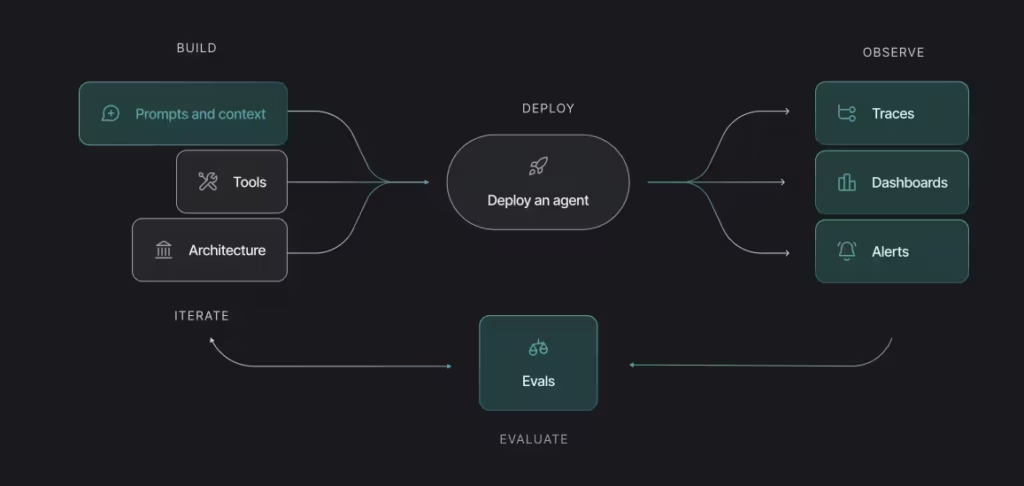
The LangChain ecosystem doesn’t just unify tools. It promotes a complete vision of agentic development, where every step—from design to deployment—is connected through shared and traceable components. This “code-to-production” philosophy relies on tight integration between LangChain, LangGraph, and LangSmith, and extends to professional solutions like LangGraph Platform (now LangSmith Deployment), which simplify production rollouts. The goal is clear: to make LangChain the backbone of modular and auditable AI applications (Sparkco AI).
In summary, LangChain is not just a framework but an evolving ecosystem. It adapts to increasing project complexity while giving teams a choice between full local control and managed cloud services. This flexibility makes it a solid foundation, though one where dependency risk and architectural complexity must be considered early in the design phase.
Main Frameworks: LangChain, LangGraph and Deep Agents
The LangChain ecosystem revolves around three complementary frameworks, each with a specific role in designing, orchestrating, and implementing artificial intelligence applications. Together, they form a consistent yet demanding foundation to master.
LangChain, the open-source foundation for building LLM applications
LangChain is the foundational core of the entire ecosystem. It is an open-source framework (MIT license) designed to simplify the creation of applications built on Large Language Models (LLMs). Its purpose is straightforward: to provide modular, reusable components for assembling AI workflows quickly and efficiently.
As explained in the official documentation, LangChain relies on several key concepts:
- Prompts and Models: unified abstractions for interacting with OpenAI, Anthropic, Google, or local models.
- Chains and Memory: sequential logic for conversation management or Retrieval-Augmented Generation (RAG).
- Tools and Agents: components capable of executing actions based on LLM instructions.
- LCEL (LangChain Expression Language): a declarative syntax that simplifies composition through the “|” operator, enabling direct chaining of components.
LangChain’s “all-in-one” approach has attracted many developers, but its richness also brings challenges. Multiple engineers on Reddit and Zaytrics have noted increasing abstraction complexity, latency overhead caused by intermediate layers, and debugging difficulties due to deeply nested chains.
Despite these caveats, LangChain remains ideal for:
- Rapid prototyping or AI proof of concepts.
- Low-traffic or internal applications.
- Learning environments, due to its wide compatibility with models and vector databases.
However, for high-load environments or mission-critical systems, it becomes more efficient to migrate toward LangGraph, which is more robust and scalable.
LangGraph, advanced orchestration for AI agents
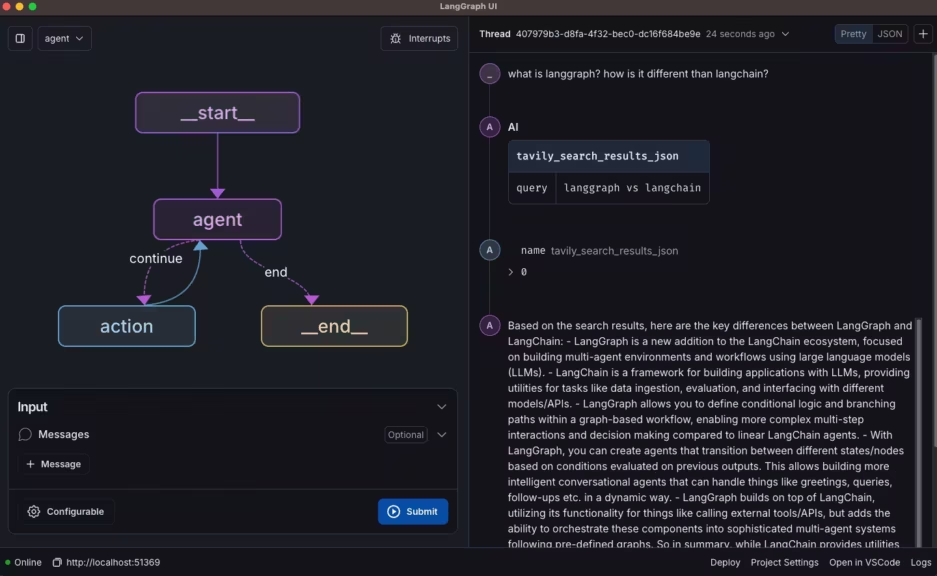
LangGraph marks a major milestone in LangChain’s evolution. While LangChain relies on linear chains of actions, LangGraph adopts a graph-based structure, where each node represents a function, model, or tool, and the connections define relationships, conditions, or execution loops.
This open-source framework (MIT license) enables orchestration of multiple interconnected AI agents capable of reasoning together, collaborating, and maintaining state over time. As explained in this overview of LangGraph, it is a stateful framework, meaning it preserves execution context, records checkpoints, and allows resuming a process from a failure point or rolling back to inspect a previous state (time-travel debugging).
Key features
- Graph architecture: models non-linear workflows with loops and conditional branches.
- Persistent state management: automatically saves agent states for recovery or audit.
- Human-in-the-loop integration: adds manual validation steps to workflows.
- Real-time streaming: live visualization of intermediate steps and outputs.
- Sub-agents: delegates tasks to specialized secondary agents.
LangGraph has proven production-ready maturity. According to LangChain, companies like Uber, LinkedIn, and Replit already use it to automate complex processes such as unit test generation, recruitment assistance, or developer collaboration.
The main difference from LangChain lies in explicit control. While LangChain hides complexity behind abstractions, LangGraph exposes the entire structure of the workflow, making it the preferred choice for enterprise-grade AI architectures.
In practice, LangGraph is to LangChain what Kubernetes is to Docker, an orchestrator designed to scale from prototype to full production. With its visual interface, LangGraph Studio, it also provides an accessible way to design and debug complex AI workflows, even for teams who prefer minimal code interaction.
Deep Agents, the autonomy layer
Built on top of LangGraph, the Deep Agents library takes the concept of autonomy a step further. Presented on GitHub and Datacamp, it provides an out-of-the-box architecture for creating intelligent agents capable of planning and learning over multiple iterations.
Core capabilities
- Hierarchical planning: tasks are decomposed into sub-steps with tracked states (pending, in-progress, completed).
- Long-term memory: persistent storage of contexts and results using a virtual file system.
- Specialized sub-agents: secondary agents assigned to roles such as search, generation, or verification.
- Native integration with LangGraph State and Store: context persistence across sessions.
Deep Agents is particularly suited for:
- Automated deep research (Open Deep Research Agent).
- Iterative code generation or analysis.
- Long-lived AI workflows that require stateful coordination across multiple agents.
Although the library is still young, it represents a natural evolution from basic tool execution (LangChain) to multi-step reasoning and autonomous systems.
The DeepAgents project is currently at version 0.2, released in late October 2025, and remains in active development with no stable release yet. According to the official GitHub repository and LangChain blog, there is still no 1.0 release, and the repository indicates “no releases published.” Licensed under MIT, the project is gaining traction with over 4,700 GitHub stars.
- July 2025: first experimental version.
- September 2025: complete rewrite on LangChain 1.0 with a new middleware architecture.
- October 2025 (v0.2): introduction of modular backends and improved LangGraph integration (LinkedIn LangChain).
Stability context
Although DeepAgents is still beta software, it relies on stable foundations: LangChain 1.0 and LangGraph 1.0, both considered production-ready (LangChain Changelog, LangChain blog). It leverages the LangGraph runtime and the new middleware architecture introduced in LangChain 1.0, ensuring a reliable technical base.
Current state
In summary, DeepAgents is an experimental yet promising project, ideal for prototyping and research on multi-agent AI systems. It is built on mature foundations but not yet recommended for production use.
Complementary Tools in the LangChain Ecosystem
Beyond the main development and orchestration frameworks, the LangChain ecosystem also includes a set of tools designed to observe, test, and deploy AI applications in production environments. These components are not always required for experimentation but become essential when targeting reliability, traceability, and scalability.
LangSmith, observability and evaluation for AI applications
LangSmith is the proprietary platform within the LangChain ecosystem, dedicated to traceability, debugging, and evaluation of LLM-based applications. It acts as a real observability cockpit, allowing developers to track every step of a workflow, from prompts to final responses.
As detailed in the official documentation, LangSmith provides several key capabilities:
- Full observability: track inputs, outputs, latency, and token usage.
- Visual debugging: display prompts and outputs side by side for analysis and optimization.
- Automated evaluation: quality metrics, A/B testing, and human feedback integration.
- Production monitoring: detect anomalies and trigger alerts in case of performance degradation.
LangSmith works with or without LangChain, making it a framework-agnostic observability tool suitable for other AI pipelines. The free Developer plan offers 5,000 traces per month with a 14-day retention period, enough for development and prototyping (LangChain Pricing).
Still, some engineers have raised concerns about potential vendor lock-in. Centralizing traces on LangSmith’s cloud may raise privacy and dependency issues, as discussed on Reddit.
For teams that prioritize privacy or independence, a self-hosted version of LangSmith is available (enterprise plan only). Open-source alternatives such as LangFuse or Aegra also exist, both providing similar observability and monitoring capabilities for AI workflows.
LangSmith Deployment and Studio: from code to production
To bridge the gap between design and production, LangChain provides two complementary tools: LangSmith Deployment (previously LangGraph Platform) and LangSmith Studio.
LangSmith Deployment
This commercial infrastructure is built to deploy LangGraph agents at scale. It manages flows, execution memory, and agent communication without requiring teams to maintain their own full stack. As noted in the official documentation, its main benefits include:
- One-click deployment via GitHub.
- APIs for state, history, and conversational memory management.
- Scalable task queues and cron-based scheduling.
- Real-time streaming and human-in-the-loop support.
The free Self-hosted Lite plan allows up to 100,000 node executions per month, sufficient for most non-critical workloads. For higher-demand environments, the Plus plan ($39/month) or Enterprise tier adds authentication, monitoring, and SLA guarantees. The largest cost usually comes from integration time, often justifying professional support, as highlighted by Metacto.
LangSmith Studio
LangSmith Studio is a visual IDE for designing and debugging agent graphs. It helps visualize component connections, run interactive tests, and inspect an agent’s state at a specific moment (time-travel debugging). The Studio is particularly valuable for developers who want to understand agent logic visually instead of parsing complex textual logs.
Open-source companion tools: LangServe, LCEL and Templates
The LangChain ecosystem also includes several free and open-source tools built to accelerate development and simplify AI deployment.
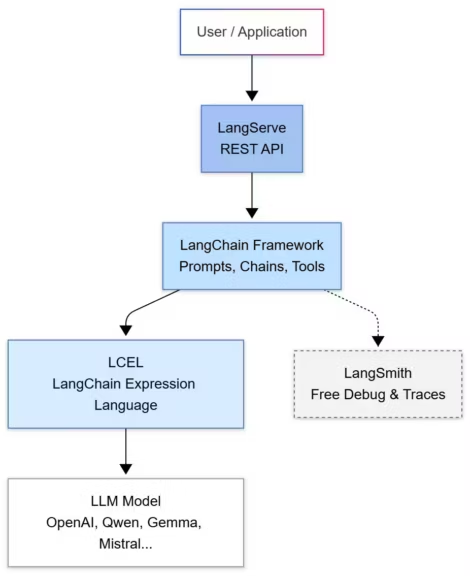
- LangServe converts any LangChain chain into a REST API, complete with automatic Swagger documentation and standard endpoints (/invoke, /batch, /stream, /stream_log). Based on FastAPI and Pydantic, it enables rapid publishing of AI services (DataCamp).
- LCEL (LangChain Expression Language) is a declarative language offering a clearer and faster alternative to traditional chains. It supports parallelism, optimized streaming, and automatic tracing through LangSmith.
- LangChain Hub and Templates provide a community library of prompts and reference app templates (ReAct, Memory Agent, RAG, etc.), helping teams prototype faster and follow consistent architectures.
Together, these tools form LangChain’s open-source toolkit, significantly lowering the entry barrier while maintaining flexibility for experienced developers.
Choosing the Right LangChain Tools for Your AI Project
Selecting the best combination of LangChain components depends on your project type, its criticality, and your team’s technical maturity. The most common mistake is trying to integrate everything at once, while LangChain was designed for progressive adoption.
Small projects, prototypes, and POCs
For exploratory or low-traffic projects, the LangChain framework alone is often sufficient. It offers fast setup, broad compatibility with open-source models like Qwen, GPT-OSS, Gemma, Mistral, or Llama 3, and a short learning curve.
Recommended setup:
- LangChain + LCEL + LangServe
- Use the free LangSmith plan for debugging
- Local or Docker-based deployment
This configuration is ideal for:
- Testing chatbot or RAG ideas.
- Evaluating model performance on business tasks.
- Internal automation prototypes.
Its main strength is ease of deployment. A developer can expose a working REST API in minutes using LangServe (Datacamp). Advanced tools like LangGraph and LangGraph Studio become relevant only once you need multi-agent workflows or persistent orchestration.
Complex applications and multi-agent systems
For ambitious projects with conditional, iterative, or distributed logic, LangGraph becomes essential. It adds state management, persistence, and an architecture natively designed for multi-agent systems.
Recommended setup:
- LangGraph + Deep Agents + LangSmith
- Vector storage (Qdrant, Chroma, FAISS) for contextual memory
- Deployment via Docker Compose or Kubernetes
This configuration fits:
- Long-term research assistants.
- Enterprise copilots integrating multiple data sources.
- Code generation or verification pipelines.
- Any advanced workflow requiring coordination across agents.
Companies like Uber, LinkedIn, and Replit already use this architecture to automate critical tasks (LangChain Blog). These case studies confirm that LangGraph provides the robustness and transparency required for production, without losing open-source flexibility.
Critical projects and regulated environments
When reliability, privacy, or compliance are top priorities, extra caution is required. While cloud services like LangSmith Deployment offer convenience, they may be unsuitable for sectors such as finance, healthcare, or defense.
Recommended setup:
- LangGraph + LangServe + open-source observability (Aegra, LangFuse)
- On-premise or private-cloud deployment
- Internal monitoring for performance and logs
This setup minimizes proprietary dependencies and reduces vendor lock-in risks. As Dashdevs explains, modularity and dependency isolation are key to future-proofing AI systems.
Summary: Which combination should you choose?
| Project Type | Recommended Tools | Main Objective | Observability Option |
|---|---|---|---|
| Quick prototype / POC | LangChain + LCEL + LangServe | Test and iterate | LangSmith Free Tier |
| Multi-agent system | LangGraph + Deep Agents | Coordination and persistence | LangSmith Self-hosted |
| Critical application | LangGraph + LangServe + Open-source monitoring | Reliability and compliance | Aegra / LangFuse |
| Long-term project | LangGraph + LangSmith Deployment | Production and scalability | LangSmith Enterprise |
The winning strategy is to start small, validate business logic with LangChain, then migrate progressively to LangGraph as complexity grows. This incremental approach reduces technical debt while preparing for long-term evolution.
Viability and Sustainability of LangChain in 2025
Choosing a framework for AI development is no longer a purely technical decision, it’s a strategic bet on long-term stability and evolution. With the significant investment of time and expertise required, companies now seek solutions that can last, evolve without breaking changes, and remain compatible with the wider open-source AI ecosystem. So the real question is, is LangChain a sustainable and future-proof choice in 2025?
Massive adoption inspires confidence
The numbers speak for themselves. LangChain enjoys strong adoption across the AI landscape:
- Over 1,300 verified companies use it in production, according to Landbase.
- A $1.25 billion valuation following a $125 million funding round in October 2025 (Fortune).
- More than 28 million monthly downloads on GitHub.
- 250,000 active LangSmith users with over one billion traces recorded (Contrary Research).
This traction shows that LangChain is far from a short-lived trend. Industry leaders like Uber, LinkedIn, Elastic, Cloudflare, and Replit have validated it in production (LangChain Blog), reinforcing its credibility as a cornerstone of the AI development ecosystem.
An ecosystem entering its stabilization phase
After a period of frequent and sometimes disruptive updates, LangChain is now entering a phase of technical maturity.
- The releases LangChain 1.0 and LangGraph 1.0 (October 2025) introduced stable APIs and backward compatibility (GitHub LangChain).
- The adoption of Pydantic 2 has completed major structural changes introduced in earlier versions.
- External integrations (LLMs, vector databases, connectors) have been split into independent packages to reduce dependency conflicts and simplify maintenance.
These moves signal a clear intent from the developers to consolidate and stabilize the project. The LangGraph documentation even states that the long-term goal is to guarantee backward compatibility, one of the most requested features among enterprise users.
Valid criticism, but manageable challenges
Despite its success, LangChain has not escaped criticism. Several technical reports have highlighted real production challenges:
- Latency overhead caused by stacked abstractions.
- Silent failures when invoking tools or sub-agents.
- Complex debugging due to deep callback nesting.
- Limited async support under heavy loads (Milvus Quick Reference).
Community feedback shows that LangChain attracts a lot of interest, yet production adoption is harder than it seems, as with many AI frameworks. It requires solid architecture design, explicit state management, and careful integration with existing systems. That said, these issues are now better understood and documented. Best practices listed in the Sparkco AI guide help mitigate them:
- Prefer LangGraph over sequential chains for complex flows.
- Isolate dependencies to avoid version conflicts.
- Monitor workflows with LangSmith or open-source alternatives.
- Containerize AI agents to ensure consistent deployments.
Such recommendations indicate that LangChain’s pain points are not structural flaws but architecture and deployment pitfalls that experienced teams can overcome.
Designing for longevity: the architectural strategy
To ensure that a LangChain-based project remains future-proof, teams must build structural resilience from the start.
- Encapsulate LangChain calls behind an abstraction layer to simplify future migration.
- Favor open-source components (LangGraph, Deep Agents, LangServe) over SaaS tools if dependency risk is a concern.
- Separate business logic from framework code to preserve portability.
- Track the official roadmap and version updates on GitHub to anticipate changes.
These principles reduce refactoring risks and help maintain an architecture that can evolve safely over time, a strategy emphasized by CTO Magazine.
A durable ecosystem, but one that demands discernment
LangChain has reached a rare position: that of a de facto standard for LLM application development. Its comprehensive ecosystem, open-source base, and wide industry adoption make it a strong strategic choice. Yet, its complexity demands architectural discipline. LangChain is not just a framework—it’s a foundation that must be used deliberately and methodically.
In short, LangChain and LangGraph are both viable and sustainable choices, provided they are used wisely, with modularity and transparency in mind.
Conclusion: Building a Sustainable AI Architecture with LangChain
LangChain is no longer just another framework, it has evolved into a complete AI engineering platform, covering the entire LLM development lifecycle—from prototyping and orchestration to observability and production deployment. This technological richness requires a clear-sighted approach: LangChain is not a shortcut, but a powerful set of tools that demand rigor, discernment, and real time investment.
In 2025, the combination of LangGraph + Deep Agents stands out as one of the most robust setups for building autonomous agents capable of persistence and coordination. However, Deep Agents remains in version 0.2, still experimental and best suited for prototyping or research. Combined with LangSmith for monitoring and LangServe for deployment, this stack outlines a coherent architecture that connects the flexibility of open-source tools with the reliability of centralized observability—though some components still need maturity and validation in production.
Ultimately, sustainability depends more on architecture than technology. A well-designed AI system should:
- Preserve independence from proprietary services.
- Clearly separate business logic from LangChain layers.
- Include abstraction layers to facilitate migration to other frameworks.
By following this approach, LangChain can serve as a solid, scalable, and future-proof foundation. It enables developers to leverage the rapid innovation of open source while retaining full control over their AI infrastructure.
For experienced teams, LangChain now represents one of the most complete and mature ecosystems on the market, as long as it is used as a flexible foundation rather than a rigid dependency.
The message is clear: Build with LangChain, but think beyond LangChain.
| Critère | LangGraph | CrewAI | Microsoft Agent Framework |
|---|---|---|---|
| Origine / Éditeur | Développé par LangChain | Projet open source indépendant | Microsoft (fusion d’AutoGen et Semantic Kernel) |
| Architecture | Basée sur un graphe d’exécution (chaque nœud = étape, outil ou sous-agent) | Organisation en équipes d’agents spécialisés (“crew”) | Infrastructure modulaire et centralisée, pensée pour la production |
| Philosophie | Orchestration robuste et mémoire persistante | Collaboration multi-agents, approche distribuée | Gouvernance, conformité et observabilité d’entreprise |
| Persistance d’état / Mémoire | Oui, via Redis, PostgreSQL ou Chroma (mémoire externe durable) | Non native, dépend des intégrations externes | Oui, intégrée à Azure (stockage et reprise de contexte) |
| Multi-LLM | Support indirect via LangChain | Oui, un LLM différent par agent possible | Oui, compatible avec plusieurs LLM via connecteurs Azure |
| Interopérabilité | Compatible LangChain, LangSmith, Qdrant, Chroma | Intégration avec +100 outils (Gmail, Notion, Slack, etc.) + MCP | Connecté à l’écosystème Microsoft (Azure, Entra ID, Power Platform) |
| Observabilité / Supervision | Oui, via LangSmith (self-hosted ou cloud) | Basique, orientée logs ou monitoring externe | Intégrée (Azure Monitor, Log Analytics) |
| Cas d’usage typique | Orchestration d’agents complexes, mémoire longue, projets multi-LLM | Collaboration IA entre rôles spécialisés, automatisation de tâches variées | Déploiements en entreprise nécessitant conformité et traçabilité |
| Niveau de maturité | Très stable, éprouvé en production | En développement actif, flexible mais moins standardisé | Récent mais soutenu par Microsoft, adoption rapide |
| Cible principale | Développeurs et architectes IA | Équipes d’automatisation et makers | Entreprises soumises à des normes de sécurité et conformité |
| Licence / Open Source | Open source (LangChain ecosystem) | Open source | Open source (MIT, Microsoft GitHub) |
Your comments enrich our articles, so don’t hesitate to share your thoughts! Sharing on social media helps us a lot. Thank you for your support!