OmniNFT for LTX-2.3: Alignment via reinforcement learning

The LTX-2.3-OmniNFT-RL-Lora_bf16.safetensors file, hosted on Kijai’s ComfyUI repository, is drawing significant curiosity from the open-source AI video community. Far from being a standard artistic style filter, this adapter introduces an advanced optimization framework to the core LTX-Video model.
What is the OmniNFT project?
The original project, developed by the zghhui research team, is fully documented on their OmniNFT project page and hosted on their official Hugging Face repository. The acronym stands for Modality-wise Omni Diffusion Reinforcement for Joint Audio-Video Generation.
The standout feature of this methodology is the application of Reinforcement Learning (RL) to video diffusion models. Instead of relying solely on traditional supervised fine-tuning (where the model learns strictly by mimicking a target video dataset), the researchers employed Reward Models to evaluate and steer the model’s outputs based on three core pillars:
- Aesthetic image quality.
- Fluidity and temporal consistency of motion.
- Textual alignment with the input prompt.
In their comprehensive research paper, the OmniNFT framework also addresses joint, synchronized audio generation. However, the specific adapter module available here focuses exclusively on refining and aligning the video dynamics within the LTX-2.3 Transformer architecture.
Kijai’s conversion work for ComfyUI
The raw files provided by the research team were not natively structured for plug-and-play inference within graphical user interfaces. Originally, the LoRA is distributed in the PEFT/Diffusers format (adapter_model.safetensors) and requires running an external Python script to permanently merge the weights into the base model before inference.
Kijai executed a thorough structural conversion:
- Key Mapping: Translated the attention layer naming conventions from the Diffusers format into the specific tensor hierarchy required by ComfyUI.
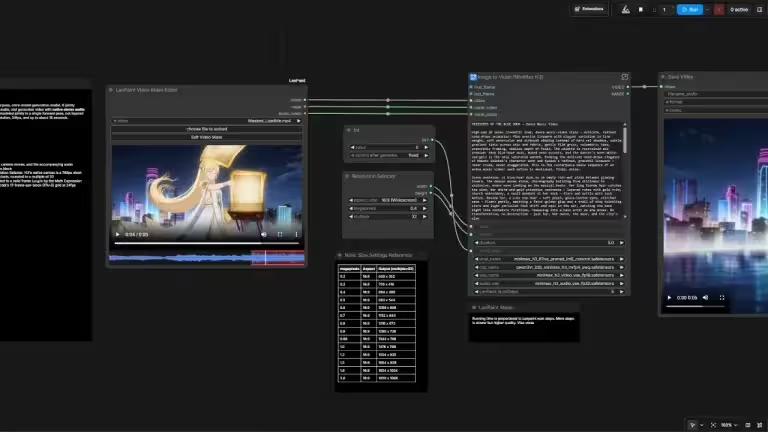
- Packaging: Consolidated the weights into a single .safetensors file that works out of the box with the standard Load LoRA node.
- Note: Converted for ComfyUI by Kijai, the file has been optimized by downcasting from FP32 precision to a BF16 (Bfloat16) format. This downcast halves the LoRA’s memory footprint while preserving computation stability and model performance on our graphics cards.
Intended improvements vs empirical test results
Theoretically, reinforcement learning alignment should deliver superior temporal consistency (minimizing face and object morphing across frames), a reduction in compression artifacts, and tighter prompt adherence.
That said, early user feedback shared within discussion #61 on Kijai’s repository introduces important real-world nuances and suggests a measured approach:
The stylistic bias hypothesis (Anime / Cartoon)
Users analyzing the official side-by-side comparisons noted that while the baseline model sometimes generated photorealistic human figures, enabling the OmniNFT LoRA could shift the output toward an animated or stylized aesthetic.
Hypothesis: The aesthetic reward models or training datasets utilized by the researchers may have carried a higher proportion of stylized content. If your goal is strict photorealism, this adapter might introduce a subtle stylistic drift.
Subtle motion and character stabilization
Community feedback indicates that the visual gains are generally subtle. The primary improvements manifest as slightly more “natural” micro-movements and enhanced structural stability when handling multiple characters or speaking anthropomorphic figures. Rather than a total visual overhaul, it acts more like a geometric stabilization pass.
ComfyUI deployment recommendations
Empirical findings from discussion #61 challenge typical LoRA configurations:
- Lowering the strength parameter: In contrast to the default strength of 1.0, which users reported could occasionally over-saturate images or stiffen motion, community consensus suggests dialling it back. Dialling the strength down to between 0.4 and 0.7 appears to capture the structural corrections while avoiding unwanted stylistic side effects.
- Sampling strategies: Kijai notes that this implementation is still very new. Pair this adapter with structural slicing methods like the LTX Tiled Sampler—particularly during high-resolution upscaling passes—to efficiently smooth out any remaining pixel shimmering.
Your comments enrich our articles, so don’t hesitate to share your thoughts! Sharing on social media helps us a lot. Thank you for your support!