MiniMax H3 text to video benchmark: multishot generation and prompt engineering on RTX 5090
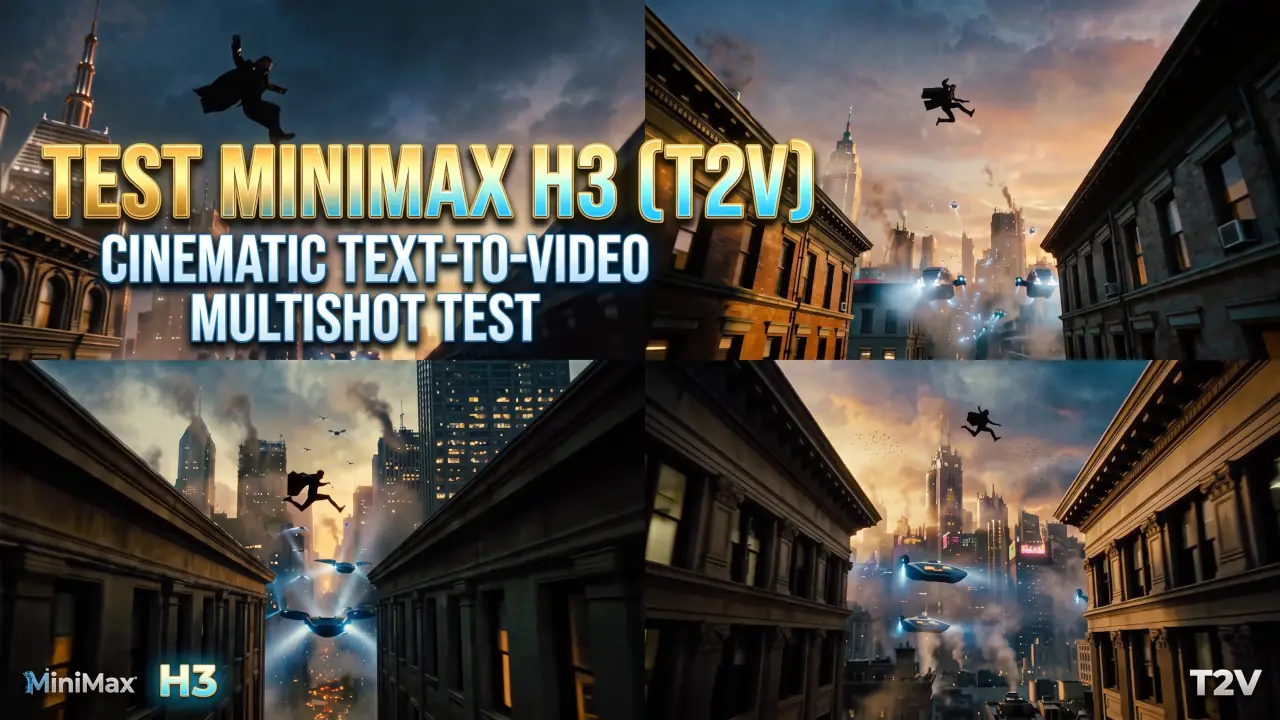
MiniMax H3 marks a clear shift in how local video generation handles narrative pacing and temporal consistency. While previous generations struggled to maintain character coherence across cut boundaries without relying on heavy ControlNet pipelines, H3 natively targets complex multishot sequences directly from text prompts.
Running multishot text-to-video inference on local consumer silicon remains one of the most computationally demanding AI workloads available. Below is a deep dive into MiniMax H3 performance on an NVIDIA GeForce RTX 5090, analyzing compute scaling between 0.5MP and 0.98MP, along with the prompt architecture required to unlock its multimodal conditioning engine.
Hardware and software setup
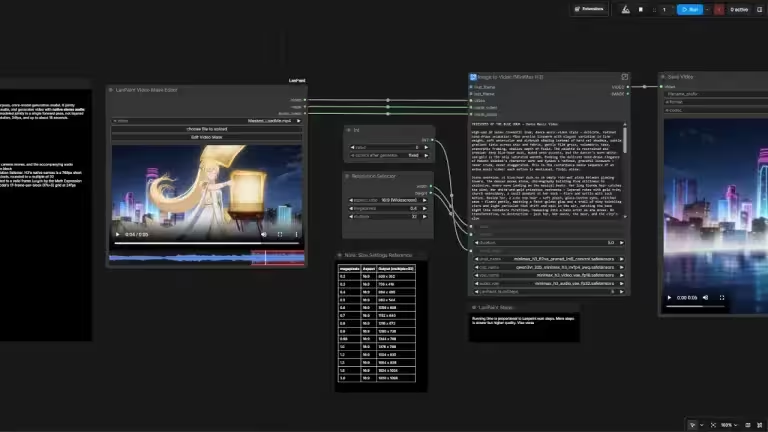
All test runs were executed locally using the native ComfyUI Text-To-Video workflow. Each sequence generated a continuous 10-second multishot video containing 4 distinct cinematic cuts with synchronized native soundscapes and score hits, produced in a single generation pass — the model resolves all four shots together from one structured prompt, not as separate chained clips.
Testbed specifications
- GPU: NVIDIA GeForce RTX 5090 (32 GB VRAM)
- Architecture: Blackwell
- Inference engine: ComfyUI 0.33.3, ComfyUI_frontend v1.49.6
- Generation parameters: 4 runs per resolution, 10 seconds total duration, randomized seed per run, 4-shot storyboard structure, Turbo mode disabled
Model files used
- minimax_h3_fl2va_pruned_int8_convrot.safetensors — diffusion model (INT8 pruned)
- minimax_h3_video_vae_fp16.safetensors — video VAE
- minimax_h3_audio_vae_fp32.safetensors — audio VAE
- qwen3vl_32b_minimax_h3_nvfp4_awq.safetensors — text/multimodal encoder (NVFP4 AWQ)
Execution metrics: 0.5MP vs 0.98MP compute scaling
Generating video across multiple sequential shots in a single inference pass exposes significant computational friction as pixel density increases. We benchmarked two primary operational resolutions: 950×544 (0.5 Megapixels) and 1344×768 (0.98 Megapixels, standard widescreen 16:9).
+-------------------------------------------------------------------------+
| MiniMax H3 Multishot (10s, 4 Shots) Generation Time on RTX 5090          |
+-------------------------------------------------------------------------+
| Resolution       | Run 1    | Run 2    | Run 3    | Run 4    | Average  |
+-------------------------------------------------------------------------+
| 950x544 (0.5MP)  | 266.13s  | 313.59s  | 368.39s  | 291.23s  | 309.84s  |
| 1344x768 (0.98MP)| 851.29s  | 928.83s  | 844.58s  | 856.65s  | 870.34s  |
+-------------------------------------------------------------------------+
950×544 (0.5 Megapixel) analysis
- Average generation time: ~5 minutes 10 seconds (309.84s)
- Performance spread: Ranged between 266.13s and 368.39s.
- Observation: At 0.5MP, the RTX 5090 maintains high efficiency. Temporal attention layers process latent frames rapidly enough to make iterative scene testing viable for production shorts.
1344×768 (0.98 Megapixel) analysis
- Average generation time: ~14 minutes 30 seconds (870.34s)
- Performance spread: Ranged between 844.58s and 928.83s.
- Observation: Doubling the pixel count nearly triples the execution duration (a 2.8x compute increase for a 1.96x resolution increase). This non-linear scaling highlights the computational cost of spatial-temporal self-attention across large latents — and, as measured below, it pushes the workload past the RTX 5090’s dedicated VRAM.
VRAM and memory behavior
At 1344×768 (0.98MP), dedicated GPU memory usage ranged from 23 GB to 26.6 GB out of 31.5 GB available on the RTX 5090 — a substantial load, but nominally within the card’s dedicated VRAM budget.
However, this workload did not stay within dedicated VRAM alone. At this same resolution, Windows’ shared GPU memory (system RAM allocated as GPU-accessible memory) was actively used during runs, at approximately 22.5 GB out of 47.9 GB available. This confirms that the 4-shot multishot pipeline at 1344×768 exceeds what dedicated VRAM alone can sustain on a 32 GB card, and relies on the shared memory fallback to complete generation. This is a likely contributor to the non-linear time scaling observed between 0.5MP and 0.98MP: once shared memory is engaged, data transfer between system RAM and VRAM adds overhead beyond pure compute scaling.
The prompt syntax bottleneck: why default templates fail
The native ComfyUI template supplies a default action-trailer prompt that mimics legacy text-to-video formats. However, MiniMax H3 utilizes a specialized conditioning schema. Supplying standard prose narrative leads to shot bleeding, missing sound synchronization, and degraded spatial adherence.
The flawed default prompt
The stock template prompt attempts to describe the entire sequence as loose natural language paragraphs:
Realistic live-action cinematic look, action movie trailer: practical film photography style, a post-rain dusk metropolis, anamorphic lens, shallow depth of field, film grain, city volumetric fog, flying-car traffic between the towers, restrained grading for a premium feel, powerful natural movement.

Scene overview: at dusk on a cluster of skyscrapers, the protagonist is being chased, sprinting and leaping across rooftops, jumping from one building's roof to the next with pursuers closing in behind. This is the escape sequence of an action movie trailer: every leap is life-or-death, thrilling and fluid.

Storyboard (each shot a separate scene, rapid cuts, all landing on the musical beats):
[0s-2s] Shot 1: high side angle: the protagonist sprinting at the roof edge, pursuers appearing in the rooftop doorway behind him, wind catching his coat.
[2s-4s] Shot 2: the protagonist leaps across the gap between buildings, body stretching mid-air, towers and flying-car light trails behind him, a slight slow-motion feel.
[4s-6s] Shot 3: he lands, rolls and rises, low-angle shot, tower shadows and fog behind him, he keeps running.
[6s-8s] Shot 4: freeze: the instant he hits the edge of the next roof and launches into the jump, silhouette, holding.

Camera: each shot its own angle, cuts clean and hard, no dissolves, a slight frame jitter on the jumps.

Audio: wind, rapid footsteps, city ambience, low score underneath, an accent hit on each leap, the score bursting at 4s, closing the last 1s.

No text, subtitles, logos or watermarks of any kind, no animation or cartoon rendering, no overly-CG look, keep the live-action texture.
The optimized multimodal prompt
To unlock accurate shot transitions, consistent character placement, and exact audio timing, the prompt must be restructured into explicit multimodal keyblocks: integrated_multimodal_description, timestamped shot blocks separating camera from visual details, diegetic audio, overall_soundscape, and non-diegetic music.
integrated_multimodal_description:
[0s-3s]
- Shot composition & camera: High side-angle medium shot, tracking right at high speed. Shallow depth of field, anamorphic lens flares, and subtle natural 35mm film grain.
- Visual: Dusk metropolis with wet asphalt rooftops reflecting orange and blue neon lights. Volumetric city fog drifts between distant skyscraper towers filled with streaming flying vehicle light trails. A male protagonist in a windblown dark trench coat sprints along the roof edge. Armed pursuers in tactical gear emerge from a rooftop doorway behind him in the background.
- Diegetic audio: Wet, rhythmic boot stomps splashing on damp gravel, heavy strained breathing, gusting high-altitude wind, and metallic door hinges slamming open.

[3s-5s]
- Shot composition & camera: Low-angle tracking shot beneath the gap, pushing forward with a subtle slow-motion feel.
- Visual: The protagonist leaps across the abyss between two towering buildings, body fully extended mid-air. In the deep background, vertical city towers and streams of airborne traffic create light streaks through the mist.
- Diegetic audio: A sudden sharp intake of breath, coat fabric snapping violently in the air, and low echoing hum from vehicle thrusters passing below.

[5s-8s]
- Shot composition & camera: Low-angle ground shot, handheld camera with a slight camera jitter upon impact, tilting and panning smoothly as he rises and continues forward.
- Visual: The protagonist hits the gravel surface of the opposite roof, absorbs the impact into a smooth shoulder roll, pops back onto his feet without losing momentum, and sprints through low-hanging fog and towering skyscraper shadows.
- Diegetic audio: Heavy thud of the landing impact on wet gravel, sliding friction of the roll, followed by rapid, accelerating sprint steps.

[8s-10s]
- Shot composition & camera: Wide silhouette shot from a low side angle, locking into a clean freeze-frame silhouette for the final second.
- Visual: He reaches the far edge of the second rooftop and launches into another wide aerial jump against the glowing dusk sky and illuminated skyscraper facades, holding mid-air in a sharp freeze-frame silhouette until the end.
- Diegetic audio: Forceful shoe push-off scraping the roof ledge, intense rushing wind envelope, snapping to absolute silence at the freeze-frame.

overall_soundscape:
Continuous high-altitude wind howling between skyscrapers, low ambient drone of airborne traffic engines, distant city sirens echoing through wet urban fog, and detailed foley for wet footsteps, coat flapping, and physical surface impacts.

non_diegetic_music:
A low, driving electronic-orchestral hybrid pulse builds tension alongside the sprinting rhythm. A heavy sub-bass impact hit lands precisely at 3.0s during the first jump, exploding into a dense percussive crescendo upon landing at 5.0s, sustaining intense momentum until an abrupt cutoff on the freeze-frame at 10.0s.
Key takeaways from prompt re-engineering
- Explicit camera tagging: Separating camera trajectory from subject movement prevents the model from conflating subject momentum with optical zooming.
- Deterministic audio sync: Defining diegetic cues and non-diegetic hits with precise timestamps ensures that foley impacts align directly with visual landings and shot transitions.
- Temporal boundaries: Bracketed timestamps ([0s-3s], [3s-5s]) guide the latent diffusion process to execute hard cuts rather than slow, morphing transitions.
Frequently asked questions
How much VRAM does MiniMax H3 multishot generation actually use?
In our own tests on an RTX 5090, at 1344×768 (0.98MP) dedicated VRAM usage ranged from 23 GB to 26.6 GB out of 31.5 GB available. Shared GPU memory was also engaged during these runs, at approximately 22.5 GB out of 47.9 GB available. In other words, at this resolution the 32 GB dedicated VRAM on the RTX 5090 was not sufficient on its own to fully contain the 4-shot workflow — the system relied on shared memory to complete generation.
Was Turbo mode used in these benchmarks?
No. All runs were executed without Turbo / acceleration LoRA, using the standard MiniMax H3 pipeline as described above.
Why does generation time vary between runs with identical settings?
Temporal diffusion models exhibit variance in step convergence depending on the complexity of movement generated by different seeds. Random seeds that produce intricate particle effects, complex lighting changes, or rapid camera pans require more intensive compute cycles per step than static compositions. Reliance on shared GPU memory, as observed in our tests, can also introduce additional variance run to run.
Conclusion and outlook
MiniMax H3 proves that multishot cinematic generation is no longer confined to post-production stitching or complex multi-node workflows. However, harnessing its capabilities requires treating prompt structure as code, and at higher resolutions it requires GPU headroom beyond what the nominal VRAM figure suggests — at 1344×768, our RTX 5090 tests show dedicated VRAM alone was not enough to sustain the 4-shot pipeline, with shared memory picking up the difference. As local hardware architectures continue to mature, structuring multimodal inputs will become just as critical as raw compute throughput for high-end local AI video production.
Your comments enrich our articles, so don’t hesitate to share your thoughts! Sharing on social media helps us a lot. Thank you for your support!