Suno AI copyright: the hidden risk of uploading your own music
Thinking about using Suno as a simple AI music assistant? Before uploading your first demo, guitar riff, or vocal recording, there’s one clause in the Terms of Service you should understand.
Uploading your own audio is one of Suno AI’s most powerful features. It can turn a rough musical idea into a polished song within minutes. But behind that convenience lies a contractual reality that many musicians overlook.
Do you really keep control of your music? What does that license actually allow? Can your uploads be used to train AI models? And does Private Mode really protect your work?
The illusion of a harmless creative tool
The rise of AI music generation has fundamentally transformed the creative workflow for musicians, producers, and content creators alike. Among the most appealing features offered by modern platforms is the ability to upload your own audio files. On paper, the promise is compelling: upload a rough guitar-and-vocal demo recorded on your phone, a bass riff captured in your studio, or a unique drum pattern, and the AI extends your composition, changes its genre, or enhances its arrangement.
This upload feature is marketed as a natural extension of human creativity. Instead of relying solely on text prompts, musicians can provide the AI with a concrete musical reference, making the creative process faster and more intuitive. For many creators, it has become an effective brainstorming tool for overcoming writer’s block or experimenting with new arrangements in minutes.
However, behind this seamless experience lies a contractual reality that many users overlook. Uploading an audio file to a cloud-based platform such as Suno is not merely a technical step required to generate music. It also means accepting Terms of Service that grant the platform a remarkably broad license over the content you submit. This often-overlooked detail raises an important question for musicians and producers alike:
What actually happens to your music after you upload it?
The contract clause almost nobody reads
To understand the implications of this feature, you have to look beyond the interface and into the platform’s Terms of Service. Like most online agreements, they are accepted by millions of users without being read. In Suno’s case, the Content License Grant section makes it clear that uploaded files may be used for purposes extending well beyond generating a single piece of music.
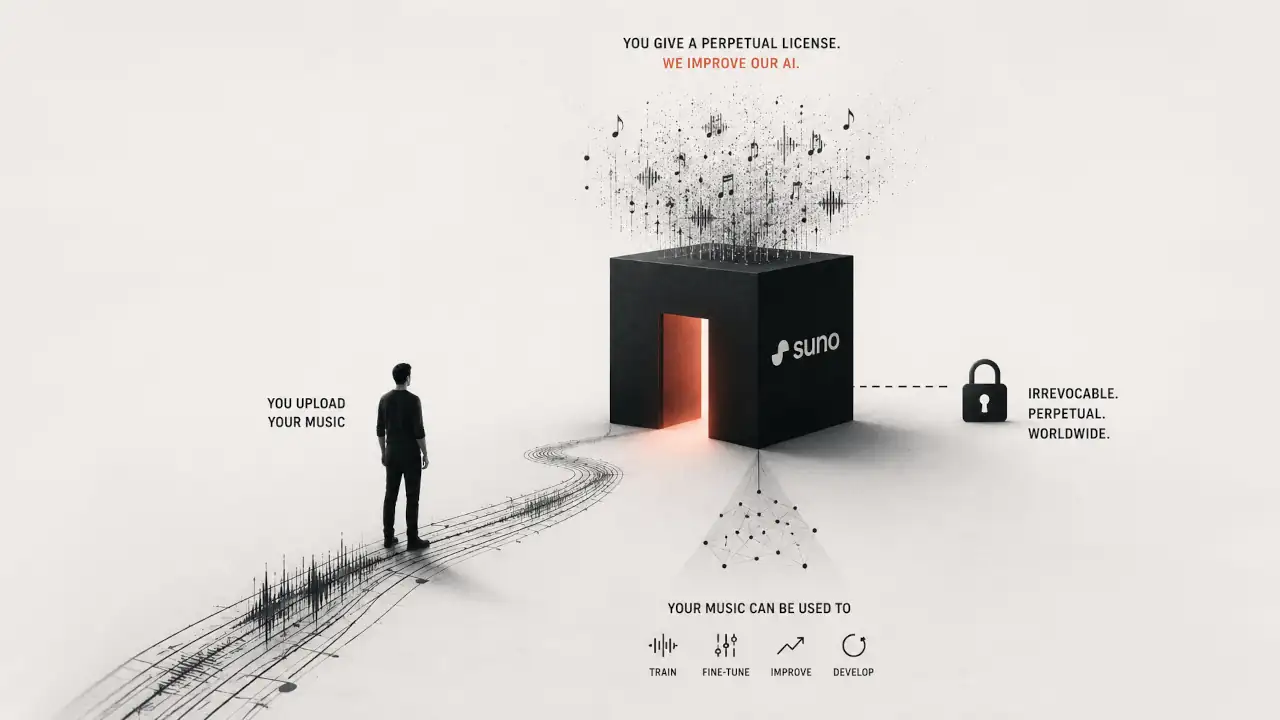
When you upload an audio file—whether it is a demo, an instrumental track, or a vocal recording—you retain ownership of your intellectual property. However, you simultaneously grant Suno a worldwide, perpetual, irrevocable, transferable, sublicensable, royalty-free license. According to the Terms of Service, this license allows the company to reproduce, modify, distribute, and otherwise use your content to provide, maintain, monetize, promote, and improve its products and services, including the development and training of its artificial intelligence and machine learning models.
This distinction is critical. You do not transfer ownership of your work, but you do grant an exceptionally broad license that significantly reduces your practical control over the files once they have been uploaded.
Many users assume that enabling Private Mode limits these rights. It does not. Private Mode only controls whether other users can see your project. It does not alter the contractual rights you have granted to Suno. Likewise, deleting a project or cancelling your subscription does not revoke the license already granted. The Terms of Service provide no mechanism for retroactively withdrawing that authorization. If your content has already been used under the rights granted by the agreement, removing every trace of its use may become extremely difficult—or impossible in practice.
Key takeaway: You remain the owner of your music, but you grant Suno an extensive license over every file you upload. The real issue is not ownership—it’s the loss of practical control.
| What many users believe | What the Terms of Service actually say |
|---|---|
| Uploading is only used to generate music. | Suno receives a broad license over uploaded content. |
| Private Mode fully protects uploaded files. | It hides projects from other users but does not change Suno’s contractual rights. |
| Deleting a project removes Suno’s rights. | The granted license is perpetual and irrevocable. |
| I lose ownership of my music. | No. You retain ownership while granting Suno a very broad license. |
Why uploading copyrighted music is a dead end
Given these contractual terms, some users may be tempted to upload commercially released songs to steer Suno toward a particular artist or musical style. In practice, this approach faces both legal and technical obstacles.
Following legal action brought by the Recording Industry Association of America (RIAA) and several major record labels, Suno appears to have strengthened its protections against copyrighted material. Although the company does not publicly explain how these systems work, the platform seems to rely on multiple mechanisms to detect protected content, whether through uploaded audio or certain text prompts. Numerous users report that uploads containing recognizable copyrighted material—or prompts explicitly referencing famous artists—may be automatically rejected.
Even if copyrighted material were to bypass these detection systems, the primary risk remains legal rather than technical. By accepting Suno’s Terms of Service, you confirm that you possess all necessary rights to every file you upload. If you do not, you—not Suno—may ultimately bear responsibility for any resulting copyright infringement claims.
The dilemma for independent artists using their own work
These contractual terms raise an important strategic question for musicians, producers, and composers. The upload feature is designed to streamline creativity, but it also means sharing part of your original work with the platform—sometimes at the earliest stages of the creative process.
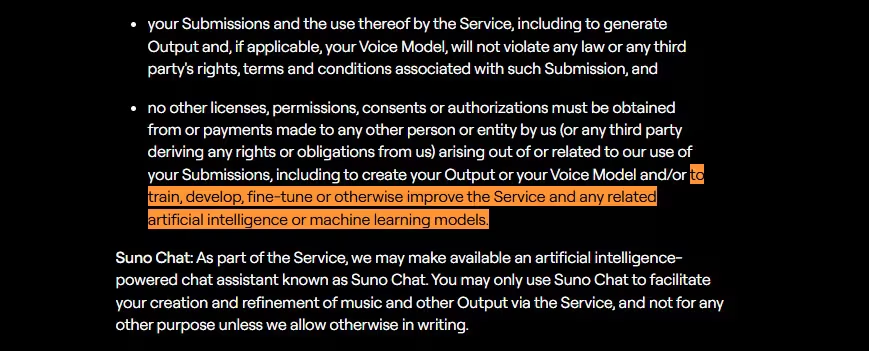
When a musician uploads a demo, a melody, or a vocal recording, they provide far more than a simple audio file. They submit an original work that may contain unique artistic decisions, distinctive production techniques, and elements of their musical identity. According to the Suno Terms of Service, the company is authorized to use this content to improve its services and its artificial intelligence models. However, Suno does not publicly disclose how individual uploads are processed or whether every uploaded file actually contributes to model training.
“…to train, develop, fine-tune or otherwise improve the Service and any related artificial intelligence or machine learning models.”
For this reason, many professionals adopt a precautionary approach. Without making assumptions about Suno’s internal AI pipeline, they prefer not to upload material they consider commercially valuable, confidential, or irreplaceable.
The paradox is particularly noticeable for Pro and Premier subscribers. These paid plans grant commercial rights over the music generated by Suno, but they do not alter the license governing uploaded files. As a result, creators may obtain commercial rights over AI-generated songs while simultaneously granting Suno a very broad license over the original material used to create them.
This situation is not unique to Suno. Many cloud-based AI platforms rely on similarly broad licenses to operate, improve their services, and develop future AI models. That is precisely why reading the Terms of Service should be considered an essential part of evaluating any AI creative tool—alongside its features, quality, and pricing.
Strategic alternatives for professional music producers
Fortunately, there are several ways to reduce these risks without giving up the advantages of AI-assisted music production.
The first strategy is to rely primarily on text prompts instead of uploading original recordings. A detailed description of the desired style, instrumentation, tempo, arrangement, or production aesthetic is often enough to generate useful results without sending proprietary material to a cloud service.
The second approach is to separate AI generation from your core production workflow. Suno can be used to create relatively generic assets—such as textures, drum loops, synthetic vocals, or songwriting ideas—which are then exported as stems and refined inside a digital audio workstation like Ableton Live, Logic Pro, or Reaper. Your original compositions remain entirely under your control.
A third strategy is simply to reserve uploads for content with limited strategic value: quick sketches, experiments, practice sessions, or ideas that are already intended for publication. Unreleased demos, commercially valuable compositions, and signature production techniques can instead remain exclusively within your local production environment.
The highest level of privacy, however, comes from running open-source music generation models locally. Projects such as ACE-Step 1.5 XL or Stable Audio 3.0 allow certain music generation and editing tasks to be performed entirely on your own hardware. Because your files never leave your computer, you eliminate the licensing concerns associated with cloud uploads while maintaining full control over your creative workflow. While ACE-Step 1.5 XL and Stable Audio 3.0 guarantees complete security locally, its current performance remains significantly inferior to that of Suno.
Before choosing an AI music platform, consider asking the following questions:
- Are uploaded files used to train AI models?
- Can this use be disabled?
- Is the granted license revocable?
- Does Private Mode change how uploaded content is handled?
- Is there a local alternative capable of meeting the same needs?
Answering these questions will quickly reveal how much practical control you retain over your own creative work.
FAQ: Suno AI and your intellectual property
Can I upload royalty-free samples to Suno?
Yes, provided that the sample’s license allows you to do so. Some sample libraries and Creative Commons licenses permit this type of use, while others explicitly prohibit granting sublicenses to third parties. Always review the original license before uploading any content.
Keep in mind that once you upload a sample to Suno, you grant the platform the license defined in its Terms of Service. Even if the sample itself is royalty-free, Suno may use it within the scope permitted by those terms.
Can Suno reuse music that I marked as private?
Private Mode only controls the visibility of your project to other users of the platform.
It does not change the contractual rights you grant to Suno when uploading a file. According to the Terms of Service, uploaded content may be used to operate, maintain, monetize, and improve the platform and its AI models. Private Mode does not alter these rights.
If I cancel my subscription, does Suno keep the rights to my uploaded files?
Yes.
The Terms of Service specify that the license granted when you upload content is perpetual and irrevocable.
In practical terms, deleting your account, removing a project, or cancelling your subscription does not automatically revoke the rights already granted to Suno over previously uploaded content.
Can I upload an unreleased demo?
Technically, yes. In fact, this is one of the intended uses of the platform.
However, if the demo represents confidential work or a commercially valuable composition, it is worth considering whether uploading it to a cloud-based service is appropriate. Many professional musicians choose to keep unreleased projects entirely within their local production environment until they are finished.
Is every uploaded file automatically used to train Suno’s AI?
The Terms of Service authorize Suno to use uploaded content to improve its services and train its artificial intelligence models.
However, the company does not publicly explain how every individual upload is processed. Therefore, it is not possible to state that every uploaded file is actually used for model training. What can be stated with certainty is that the Terms of Service give Suno the contractual right to do so.
Conclusion
AI music generation opens up remarkable creative opportunities for musicians, producers, and content creators. At the same time, it introduces new contractual considerations that deserve careful attention. Uploading an audio file is not merely a technical action—it is also a legal agreement that can have long-term implications for your intellectual property.
With Suno, you retain ownership of your music. However, you also grant the platform an exceptionally broad license over everything you upload, including rights related to operating, improving, promoting, and developing its services and AI models. This distinction—ownership versus practical control—is often overlooked, yet it can be significant for professionals working on confidential or commercially valuable projects.
This does not mean cloud-based AI music platforms should be avoided altogether. Rather, they should be used strategically. Reserve uploads for non-sensitive material, rely on detailed text prompts whenever possible, and consider running open-source models locally for projects where confidentiality is essential.
As AI music generation continues to evolve, the most important question may no longer be what these tools can create, but under what conditions creators should entrust them with their original work.
Your comments enrich our articles, so don’t hesitate to share your thoughts! Sharing on social media helps us a lot. Thank you for your support!